

For Corvette C1 enthusiasts, a string of letters and numbers can reveal the beginning of a car's story.
Is that Corvette really a 1957? Where was it assembled? What does the VIN say about that 1955 Corvette's original engine?
Welcome to the fascinating world of Corvette C1 VIN decoding.
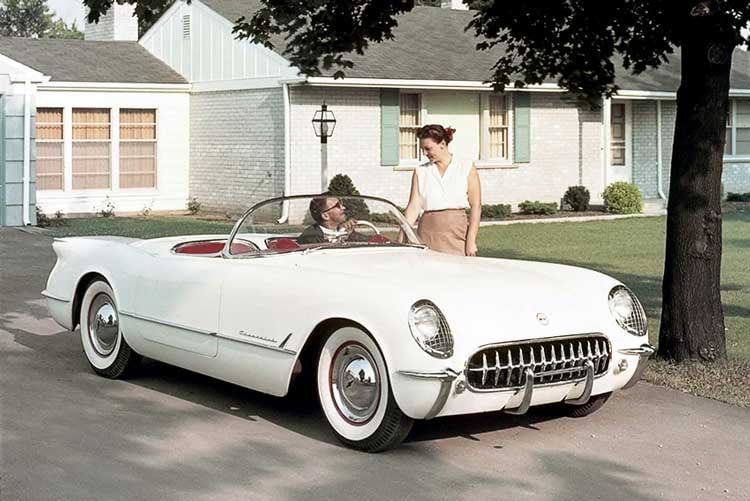
Above: 1953 Corvette C1 (photo courtesy of GM Media Archives) and lead photo of a 1955 Corvette (photo courtesy of Mecum Auctions)
From the first 300 hand-assembled 1953 roadsters through the final 1962 models, Chevrolet evolved the Corvette's vehicle identification system several times in concert with changes to America's Sports Car, the First Generation. Early Corvettes carried relatively short serial numbers.
For an owner, restorer, collector, or prospective buyer, knowing how to read these numbers can reveal important information about a Corvette's identity.
There's one rule worth remembering from the start, however:
A VIN tells you what Chevrolet encoded into the VIN. It doesn't necessarily tell you everything about the car.
Especially with valuable C1 Corvettes, the VIN should be considered the beginning of the investigation rather than the final word. Engine stampings, casting numbers and dates, trim tags, transmission and axle identification, factory paperwork, and other documentation may all play important roles in establishing a Corvette's original configuration. With that distinction established, grab a flashlight and let's decode the first generation of America's Sports Car.
C1 Corvette VIN Decoder Quick Reference
|
Generation |
Model Years |
What to Know |
|
C1 |
1953-1962 |
Several serial-number formats were used. Numbers generally identify model/year, assembly plant, and production sequence. |
C1 Corvette VIN Decoder: 1953-1962
The C1 is where the Corvette story began - and where Corvette VIN decoding can get particularly interesting.
Chevrolet changed the identification-number format several times during the first generation, so let's work through the C1 chronologically.
1953 Corvette VIN Decoder
It doesn't get much more historically significant than this:
E53F001001
That's the serial number assigned to the first production Corvette.
Here's the basic breakdown:
E — Corvette series designation
53 — 1953 model year
F — Flint, Michigan assembly plant
001001 — Production sequence
Video: 1953 Chevrolet Corvette - The 1st Ever Produced!!!
The 300th and final 1953 Corvette was numbered E53F001300.
That narrow range makes the inaugural model year wonderfully straightforward from an identification standpoint: a genuine production 1953 Corvette should fall within that 300-car sequence.
All 300 production Corvettes for 1953 were powered by Chevrolet's 235-cubic-inch Blue-Flame inline-six and equipped with a Powerglide automatic transmission.
1953 Corvette VIN Example

Above: Serial number: E53F001215 - E - Corvette series designation, 53 - 1953 model year, F - Flint, Michigan production plant, 1953 Corvette with 235 cubic inch Blue Flame six, two speed automatic Powerglide transmission, No. 215 of 300 Produced (photo courtesy of Mecum Auctions)
1954 Corvette VIN Decoder

Above and below: Serial number: E54S003963 - E - Corvette series designation, 54 - 1954 model year. Chevrolet's 1954 Corvette serial-number range ran from E54S001001 through E54S004640. Since Chevrolet began the sequence at 001001, serial number 003963 represents the 2,963rd Corvette produced for the 1954 model year. 1954 Corvette, one of 300 in Pennant Blue with a beige interior and its original straight-six 150 horsepower Blue-Flame engine (photos courtesy of Mecum Auctions)


Above: Press information for the 1954 Corvette showed six black Corvettes in the press photo. However, The 'Corvette Black Book' indicates just four were produced (photo courtesy of Mecum Auctions). Serial number: E54S001744 = 1954 Chevrolet Corvette, assembled at the St. Louis, Missouri plant; the 744th of 3,640 Corvettes produced for the 1954 model year.
There's an interesting detail regarding E54S001744 - because it is the 744th car, it falls well before serial sequence 002906, which a detailed C1 reference identifies as the approximate changeover from the early-style “bullet” air cleaners to the later dual-pot air-cleaner arrangement. Consequently, an accurately restored #744 should exhibit the early-production engine-bay characteristics rather than the later 1954 configuration. Decoding an early Corvette isn't simply about determining the model year and production number. The car's position within the production run can also help determine which components and production details are historically appropriate.
Corvette production shifted from Flint, Michigan, to St. Louis, Missouri, during the 1954 model year, and the serial number reflects the change. The above jet black beauty shows an S in the VIN code, so this baby was produced in St. Louis, Missouri.
A 1954 Corvette VIN follows this general format:
E54S001001
Breaking it down:
E — Corvette
54 — 1954 model year
S — St. Louis assembly
001001 — Production sequence
That little S is an important letter in Corvette history.
St. Louis would remain the home of Corvette production for more than a quarter-century before manufacturing moved to Bowling Green, Kentucky, during the 1981 model year.
1955 Corvette VIN Decoder

Above and below: Serial number: VE55S001622 = V - V8 - 1955 first production year for the Corvette, E - Corvette series, 55 - 1955 model year, S - St. Louis, Missouri assembly plant, 1622 - Because 1955 Corvette serial numbers began at 001001, you subtract 1,000 from the serial sequence: 1,622 − 1,000 = 622 (of the 700 constructed for the 1955 model year) - This 1955 Corvette sports a transparent hardtop and its original 265 cubic inch V8, which is backed by a three-speed manual transmission (photos courtesy of Mecum Auctions). It's one of 15 painted in Corvette Copper. The exterior hue and the transparent hardtop really bring out the cool factor to be sure!

Video: 1955 Corvette Convertible V8 (courtesy of Mecum Auctions)
The 1955 Corvette occupies a special place in the model's history because this was the year Chevrolet's new small-block V8 became available.
And Chevrolet provided a clue right in the serial number.

A V8-powered 1955 Corvette can carry a serial number beginning:
VE55S...
The V prefix denotes the V8 engine.

That makes the 1955 model year especially interesting for VIN enthusiasts because the identification number itself helps distinguish a V8 car.
This was a pivotal moment for Corvette. The original six-cylinder roadster was beginning its transformation into the V8-powered performance car that would ultimately define the nameplate.

1956-1957 Corvette VIN Decoder

Above and below: Serial number: E56S003563 = E - Corvette series, 56 - 1956 model year, S - St. Louis, Missouri assembly plant, 3563 - the 2,563rd Corvette produced for the 1956 model year, out of 3,467 total 1956 Corvettes built - 1956 Corvette convertible with a 265 cubic inch V8 that makes 225 horsepower and is backed by a three-speed manual transmission (photos courtesy of Mecum Auctions)

Video of this 1956 Corvette (courtesy of Mecum Auctions)
For 1956 and 1957, the C1 continued to use relatively straightforward serial-number formats.
Typical examples include:
E56S001001
and:
E57S100001
The key information includes:
E — Corvette series
56 or 57 — Model year
S — St. Louis assembly
Final digits — Sequential production number

The 1957 model year is particularly important to Corvette performance history. Chevrolet's small-block grew to 283 cubic inches, and optional Rochester mechanical fuel injection helped produce the famous one-horsepower-per-cubic-inch 283-horsepower specification.
But here's where Corvette VIN decoding and Corvette authentication begin to part company.
Does a 1957 Corvette VIN Prove It Was Fuel Injected?
No.
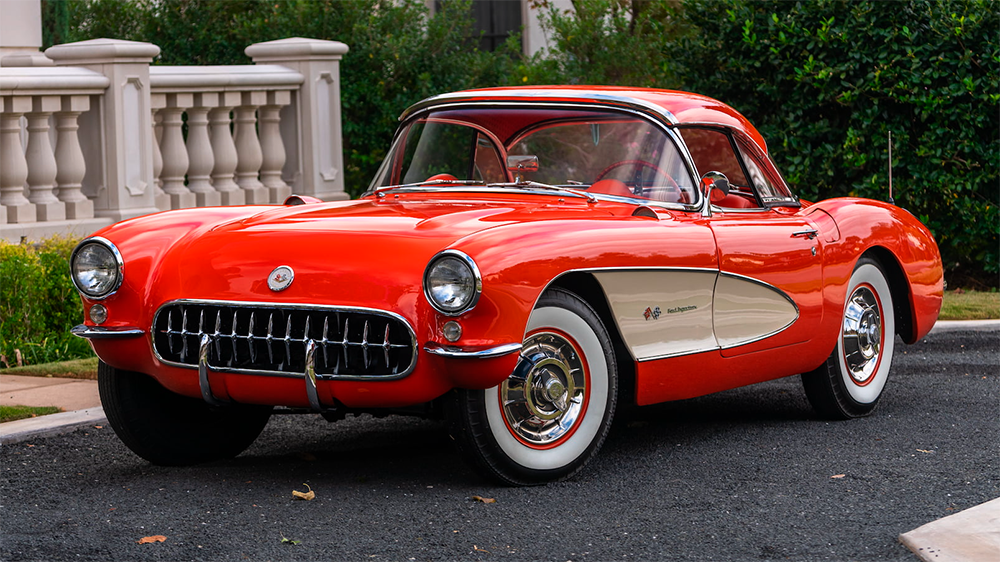
Above and below: Serial number: E57S106321 = E - Corvette series, 57 - 1957 model year, S - St. Louis, Missouri assembly plant, 106321 - production sequence number - 6,321 of 6,339 constructed for 1957 model year - The mechanically fuel-injected 283-cubic inch V8 engine in the 1957 Corvette produced a magnificent 283-horsepower (photos courtesy of Mecum Auctions). That one horsepower to one cubic inch displacement ratio was a remarkable feat of engineering back in the day. Check out the Rochester mechanical fuel injection system atop the 1957 283's powerplant just below. 1957 also is the first year that the four-speed manual transmission was available for the Corvette.
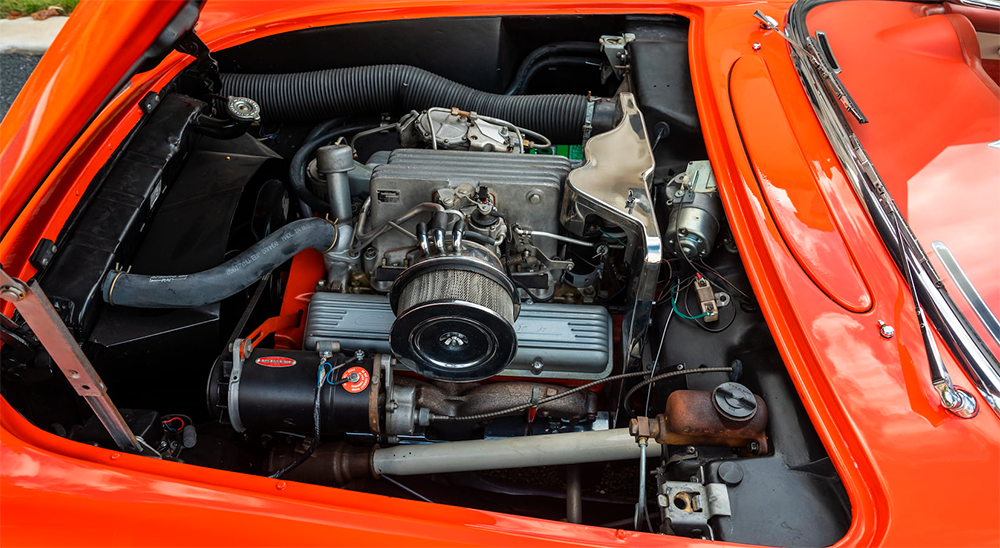

The VIN can help establish that the car is a 1957 Corvette, but it does not by itself prove that the car left St. Louis with a particular 283 engine combination or Rochester fuel injection.
If you're inspecting a valuable fuel-injected C1, the investigation needs to go considerably deeper than the VIN.

1957 Engine Suffix Code Stamped On the Engine Pad
For a 1957 Corvette, the key identifier is the engine suffix code stamped on the engine pad. That suffix tells you both the engine configuration and, in most cases, whether the car was paired with a manual or Powerglide automatic transmission.
For the 283-cubic-inch V8, the main 1957 Corvette suffix codes are:
|
Engine Suffix |
Induction / Output |
Transmission |
|
EG |
283ci, 270 hp, dual 4-barrel carburetors |
Manual |
|
EH |
283ci, 245 hp, dual 4-barrel carburetors |
Manual |
|
EL |
283ci, 283 hp, Rochester fuel injection |
Manual |
|
EM |
283ci, 250 hp, Rochester fuel injection |
Manual |
|
FG |
283ci, 245 hp, dual 4-barrel carburetors |
Powerglide automatic |
|
FH |
283ci, 283 hp, Rochester fuel injection |
Powerglide automatic |
|
FK |
283ci, 250 hp, Rochester fuel injection |
Powerglide automatic |

The important distinction is this: EG, EH, and FG are carbureted 283s; EL, EM, FH, and FK are fuel-injected 283s. The suffix also tells you whether the original combination was intended for a manual transmission or the two-speed Powerglide automatic. Chevrolet offered the 1957 283 in 220-, 245-, 250-, 270-, and 283-horsepower forms, with the 250- and 283-horse versions using Rochester mechanical fuel injection.
In other words, a claimed factory fuel-injected 1957 Corvette should first be checked for an EL, EM, FH, or FK engine suffix, then the rest of the engine and fuel-injection hardware should be authenticated against the car’s build period.
1958-1959 Corvette VIN Decoder

Above and below: Serial number: J58S108137 = J - Corvette series, 58 = 1958 Corvette, S = St. Louis, Missouri assembly plant, 8137 = the 8,137 built out of 9,168 constructed in 1958 - 1958 Corvette convertible with Rochester fuel-Injected 283/290 HP V-8, Bloomington Gold Certified, NCRS Top Flight, Triple Crown Recipient (photo courtesy of Mecum Auctions)

Chevrolet changed the Corvette series prefix for 1958.
Instead of the earlier E, the identification number now began with J.
Typical examples:
J58S100001
J59S100001
The breakdown is straightforward:
J — Corvette series
58 or 59 — Model year
S — St. Louis
Remaining digits — Production sequence
It's a small change, but exactly the sort of detail that makes a year-specific Corvette VIN guide useful.
How Can You Tell if a 1958-1959 Corvette Was Originally Fuel Injected?

As with the 1957 Corvette, the VIN on a 1958 or 1959 Corvette does not identify whether the car was originally equipped with Rochester fuel injection. Instead, one of the most important clues is the two-letter engine suffix code stamped on the engine assembly pad at the front of the 283-cubic-inch small-block V8.
Fortunately for restorers, Chevrolet's engine suffix codes clearly distinguish the carbureted and fuel-injected 283s, as well as manual-transmission and Powerglide two-speed automatic applications.

|
Suffix |
283 V8 Configuration |
Induction |
Transmission |
|
CQ |
230 hp |
Single 4-barrel |
Manual |
|
CR |
250 hp |
Rochester fuel injection |
Manual |
|
CS |
290 hp |
Rochester fuel injection, high-lift cam |
Manual |
|
CT |
245 hp |
Dual 4-barrels |
Manual |
|
CU |
270 hp |
Dual 4-barrels, high-lift cam |
Manual |
|
DG |
230 hp |
Single 4-barrel |
Powerglide |
|
DH |
250 hp |
Rochester fuel injection |
Powerglide |
|
DJ |
245 hp |
Dual 4-barrels |
Powerglide |

These suffix assignments are documented for both the 1958 and 1959 Corvette.
Therefore, when investigating a purported factory fuel-injected 1958 or 1959 Corvette, the key suffixes are easy to remember:
CR = 250-hp fuel-injected 283 with manual transmission
CS = 290-hp fuel-injected 283 with manual transmission
DH = 250-hp fuel-injected 283 with Powerglide automatic


Above and below: Serial number: J59S102243 = J - Corvette series, 59 - 1959 model year, S - St. Louis assembly plant, 2,243 built out of 9,670 convertibles constructed for the 1959 model year - 1959 Corvette convertible dual-quad carbureted 283/270 HP, four-Speed manual (photos courtesy of Mecum Auctions)

There is no 290-hp fuel-injected Powerglide combination in the regular 1958-1959 engine-suffix listings. Chevrolet's production information for 1959 specifically states that Powerglide was available with the 230-, 245-, or 250-horsepower engines, reinforcing that the hotter 290-horsepower fuel-injected engine was a manual-transmission combination.
The carbureted engines can likewise be distinguished readily: CQ identifies the 230-horsepower single-four-barrel/manual combination, CT the 245-horsepower dual-quad/manual engine, and CU the hotter 270-horsepower dual-quad/manual engine. With Powerglide, DG identifies the 230-horsepower four-barrel engine and DJ the 245-horsepower dual-quad version.

The fuel-injection hardware provides another level of authentication. For 1958, Chevrolet used several Rochester units for the 250- and 290-horsepower engines, including the 7014800/7014800R, 7014900/7014900R, 7014960, and late-production 7017200 units. For 1959, documented units include the 7014900, 7014900R, 7017200, 7017250, and additional 7017300-series units. The exact unit should therefore be evaluated according to horsepower rating and production period rather than simply confirming that a Rochester fuel-injection system is present.

As with any valuable early Corvette, however, finding CR, CS, or DH stamped on the engine pad should be considered the beginning of the authentication process—not the end. The engine's assembly date and suffix, block casting number and date, cylinder heads, distributor, Rochester fuel-injection unit, transmission, and other date-coded components should form a logical timeline relative to the Corvette's assembly date.
In short, for 1958-1959 Corvettes: CR, CS, and DH mean fuel injection; CQ, CT, CU, DG, and DJ mean carburetion.

The CR/CS distinction is particularly useful. CR is the relatively milder 250-hp fuelie, while CS identifies the coveted 290-hp fuel-injected/high-lift-cam engine. Chevrolet offered RPO 579 (250 hp) and RPO 579D (290 hp); in 1958, Chevrolet built 504 of the 250-hp fuel-injected cars and 1,007 of the 290-hp versions.
1960-1962 Corvette VIN Decoder

Above and below: Serial number: 00867S107290 = 0 - 1960 model year, specifically the 7,290 Corvette convertible built in 1960 out of 10,261 constructed for the 1960 model year (S = St. Louis assembly plant) - Photographer's magic light/even light/beauty shot of a 1960 Corvette Fuel-Injected 283/290 HP V-8, Bloomington Gold Certified, Duntov Mark of Excellence, Triple Diamond award winner (photos courtesy of Mecum Auctions) - Notice the rear of the 1960 'Vette still has the 1956-60 styling. The 1961-62 Corvettes will receive the C2 Corvette rear treatment with the four round tailights, two on each side.


Above: Engine Code shown - CS = 283/290 HP Rochester Fuel-Injection, High Lift Cam, Manual Transmission; 107290 = the 7,290 Corvette convertible built in 1960 out of 10,261 constructed for the 1960 model year; F0426 = Flint, Michigan engine assembly plant, engine constructed on April 26, 1960

Above: Please remember ladies and gentlemen - Corvettes are meant to be driven and enjoyed with gusto!

For 1960, Chevrolet changed the Corvette identification format again.
Examples include:
00867S100001 — 1960
10867S100001 — 1961
20867S100001 — 1962

Above and below: Serial number: 10867S106485 (6,485 built out of 10,939 convertibles constructed for 1961; S = St. Louis assembly plant) - 1961 Corvette convertible big brake fuelie - 1 of 233 Produced, Fuel-Injected 283/315 HP V-8, Highest Known Combined Scoring Bloomington Gold and NCRS 1961 Corvette (photos courtesy of Mecum Auctions)


The first character identifies the last digit of the model year:
0 = 1960
1 = 1961
2 = 1962
The S identifies St. Louis assembly, while the final six digits represent the sequential production number.
By 1962, the C1 Corvette had reached the end of an extraordinary transformation. The 327-cubic-inch small-block had arrived, output reached as high as 360 horsepower with fuel injection, and the Corvette was poised for its most dramatic reinvention yet.
Decoding 1960-1962 C1 Corvette Engine Codes
For the final three years of C1 production, the engine assembly suffix provides considerably more information than the Corvette VIN itself. The two-letter suffix stamped on the engine pad identifies the engine's original horsepower and induction system and whether it was intended for a manual transmission or Powerglide automatic.
The 1960 and 1961 Corvettes used the 283-cubic-inch small-block, while 1962 brought the larger 327-cubic-inch V8 and an entirely new set of engine suffix codes.
1960 Corvette 283 Engine Codes

Above: 1960 283 V8 - Engine code: DJ -283/245 hp Dual 4-barrels backed by a Powerglide automatic (photo courtesy of Mecum Auctions)
The 1960 Corvette offered an unusually broad selection of 283s ranging from the 230-horsepower four-barrel engine to the high-performance Rochester fuel-injected version.
|
Code |
Engine |
Induction |
Transmission |
|
CQ |
283/230 hp |
Single 4-barrel |
Manual |
|
CR |
283/250 hp* |
Rochester fuel injection |
Manual |
|
CS |
283/290 hp* |
Rochester fuel injection, high-lift cam |
Manual |
|
CT |
283/245 hp |
Dual 4-barrels |
Manual |
|
CU |
283/270 hp |
Dual 4-barrels, high-lift cam |
Manual |
|
DG |
283/230 hp |
Single 4-barrel |
Powerglide |
|
DJ |
283/245 hp |
Dual 4-barrels |
Powerglide |
Thus, for a 1960 Corvette, CR and CS are the two principal suffixes identifying a factory fuel-injected engine, while CQ, CT, CU, DG, and DJ identify carbureted combinations. Unlike 1959, there was no regular-production fuel-injected/Powerglide combination listed for 1960.
There's an interesting historical wrinkle concerning horsepower. Chevrolet advertised new aluminum-cylinder-head fuel-injected engines at 275 and 315 horsepower for 1960, but surviving production information indicates the aluminum heads were not released for normal production. Cast-iron-head fuelies corresponding to the earlier 250- and 290-horsepower configurations were installed instead. This explains why some period literature and later references appear to disagree over 1960 fuel-injected horsepower ratings.
1961 Corvette 283 Engine Codes

Above: 1961 283 V8 - Engine code: CS 283/315 hp Rochester fuel injection, high-performance, Manual four-speed transmission (photo courtesy of Mecum Auctions)
The basic suffix-code arrangement remained familiar for 1961, but the fuel-injected 283 received genuine horsepower increases.
|
Code |
Engine |
Induction |
Transmission |
|
CQ |
283/230 hp |
Single 4-barrel |
Manual |
|
CR |
283/275 hp |
Rochester fuel injection |
Manual |
|
CS |
283/315 hp |
Rochester fuel injection, high-performance |
Manual |
|
CT |
283/245 hp |
Dual 4-barrels |
Manual |
|
CU |
283/270 hp |
Dual 4-barrels |
Manual |
|
DG |
283/230 hp |
Single 4-barrel |
Powerglide |
|
DJ |
283/245 hp |
Dual 4-barrels |
Powerglide |
For 1961, CR unmistakably identifies the 275-horsepower fuel-injected 283, while CS identifies the top-dog 315-horsepower fuelie. Chevrolet's own 1961 Corvette information also lists Rochester 7017310 fuel injection for the 275-horsepower engine and 7017320 for the 315-horsepower version.
Notice something else: neither fuel-injected engine was offered with Powerglide. For 1961, DG and DJ are the automatic-transmission suffixes, representing the carbureted 230- and 245-horsepower engines respectively.
1962 Corvette: The 327 Arrives

Above: "This cutaway illustration of the fuel-injected 1957 Corvette engine was created by David Kimble for GM. The distributor-driven fuel pump and fuel reservoir are clearly visible at top, as is the throttle airflow meter’s throttle plate. A brass-colored injector can also be seen in a cylinder’s intake port on the engine’s right bank. GM/David Kimble"

Above and below: Serial number: 20867S101968 = 1962 Chevrolet Corvette convertible, assembled at the St. Louis Corvette plant on October 30, 1961. It was the 1,968th of 14,531 Corvettes produced for the 1962 model year. The car was delivered new through Logan Chevrolet Co. in Walla Walla, Washington, and purchased by Delbert J. Willenborg of Lewiston, Idaho.

For 1962—the final year of the C1—Chevrolet retired the Corvette's 283 and increased small-block displacement to 327 cubic inches. Horsepower now ranged from 250 to an impressive 360, and Chevrolet introduced a new family of engine suffix codes.
|
Code |
Engine |
Induction |
Transmission |
|
RC |
327/250 hp |
4-barrel |
Manual |
|
RD |
327/300 hp |
4-barrel |
Manual |
|
RE |
327/340 hp |
4-barrel, high-performance |
Manual |
|
RF |
327/360 hp |
Rochester fuel injection |
Manual |
|
SC |
327/250 hp |
4-barrel |
Powerglide |
|
SD |
327/300 hp |
4-barrel |
Powerglide |
For Corvette enthusiasts, RF is the big one. It identifies the 327/360-horsepower Rochester fuel-injected engine—the hottest engine available in the final C1 Corvette. Chevrolet used Rochester 7017355 and 7017360 fuel-injection units during 1962 production.

Above and below: RE = the 327 cubic inch V8 that makes 340 horsepower, the original, matching numbers engine in this survivor' 62 Corvette -That decal on the valve cover says 340. The odometer reading for the interior photo shows 12,014 fully documented original miles (as you can see in the first photo depicting this Corvette).


The high-performance 327s were manual-transmission-only combinations. RE identifies the carbureted 340-horsepower engine, while RF identifies the fuel-injected 360-horsepower version. Powerglide was limited to the 250- and 300-horsepower engines, identified by SC and SD respectively.
The Engine Code Is Only the Beginning

As with earlier C1 Corvettes, finding the correct suffix does not automatically prove that the engine is original to the car. Authentication should also consider the engine assembly stamping, block casting number and date, cylinder-head castings, carburetor or Rochester fuel-injection unit, distributor, transmission, and the chronology of the engine's assembly relative to the Corvette's production date.
The 1962 Corvette gives restorers an additional advantage: the engine carries a VIN derivative incorporating the vehicle's production sequence, providing another important means of determining whether a correctly coded 327 actually belongs to that particular Corvette.

For a quick enthusiast's reference, remember it this way:
1960: CR and CS = fuel-injected 283
1961: CR and CS = fuel-injected 283
1962: RF = fuel-injected 327

And 1962 represents an important bridge in Corvette history: the 327/360 RF fuelie that closed out the C1 era carried directly into the revolutionary 1963 Sting Ray, where the fuel-injected 327/360 again used the RF suffix.
That arrived in 1963... So, stay tuned to this very website for the 1963-1967 Corvette C2 VIN decoder article... Coming Soon!
Restore Your Classic Corvette with Classic Industries
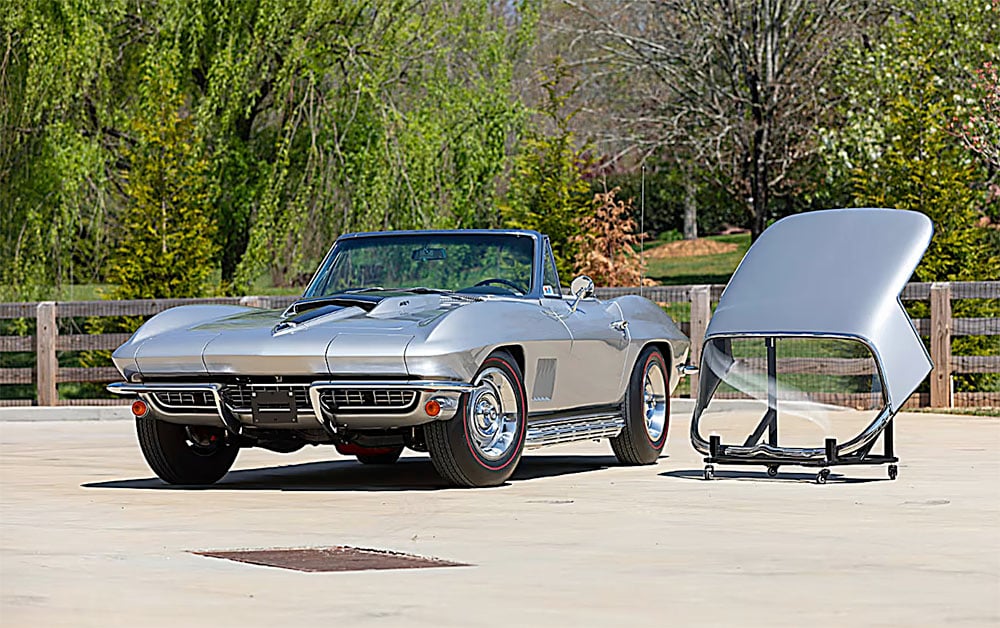
Above: L71 427 big block V8 equipped and Muncie four-speed manual backed 1967 Corvette convertible replete with removable hardtop and folded soft top - something to look forward to reading about in the C2 Corvette VIN decoding and investigating article (photo courtesy of Mecum Auctions). Here's another informative article about the C1 - C8 Chevrolet Corvette: Corvette Generations: C1-C8 History, Design Differences, and Features
Once you've decoded your Corvette C1 and documented what you have, you can make informed decisions about where to take the car next.
Whether you're preserving an original survivor, returning a vintage Corvette to factory specifications, rebuilding a longtime driver, or creating a personalized restomod, Classic Industries offers restoration, replacement, maintenance, appearance, and performance components for classic Chevrolet Corvettes.
Before ordering restoration parts, verify the Corvette's model year, body configuration, drivetrain, production details, and existing components, since Chevrolet made numerous changes throughout the 10-year span of the Corvette C1 production.
Decode the numbers. Document the Corvette. Make your restoration plan.
Then get America's Sports Car back where it belongs—on the road.

It Bears Repeating -- Decode It Before You Restore It
If you've just dragged home a C1 project, there's a natural temptation to start tearing into it immediately.
Resist that temptation for an afternoon.
Before turning the first wrench:
Photograph the VIN tag.
Photograph the trim/body tag.
Record the engine stamp.
Record engine casting numbers and dates.
Record transmission identification.
Record differential codes.
Photograph factory labels and markings.
Search the car carefully for surviving paperwork.
Document unusual components before removing them.
And don't automatically throw away old parts because they're rusty, greasy, torn, or ugly.
That weathered component may contain a date code, casting number, part number, factory marking, or construction detail that becomes invaluable later.
A good rule for any vintage Corvette restoration is:
VIN First. Documentation Second. Wrenches Third. "Have Fun In Your Garage" - Griot's Garage
But Wait... There's More!

Above: 1961 Jewel Blue and Ermine White Corvette convertible (photo courtesy of Mecum Auctions)
|
Model Year |
Factory Exterior Colors |
|
1953 |
Polo White |
|
1954 |
Polo White, Pennant Blue, Sportsman Red, Black |
|
1955 |
Polo White, Pennant Blue Metallic, Corvette Copper Metallic, Gypsy Red, Harvest Gold |
|
1956 |
Onyx Black, Aztec Copper, Cascade Green, Arctic Blue, Venetian Red, Polo White |
|
1957 |
Onyx Black, Aztec Copper, Cascade Green, Arctic Blue, Venetian Red, Polo White, Inca Silver, Aztec Copper/Beige, Cascade Green/Beige, Venetian Red/Beige |
|
1958 |
Charcoal Metallic, Snowcrest White, Silver Blue Metallic, Regal Turquoise Metallic, Panama Yellow, Signet Red, Tuxedo Black, Inca Silver |
|
1959 |
Tuxedo Black, Classic Cream, Frost Blue, Crown Sapphire, Roman Red, Snowcrest White, Inca Silver |
|
1960 |
Tuxedo Black, Tasco Turquoise, Horizon Blue, Honduras Maroon, Roman Red, Ermine White, Sateen Silver, Cascade Green |
|
1961 |
Tuxedo Black, Ermine White, Roman Red, Sateen Silver, Jewel Blue, Fawn Beige, Honduras Maroon |
|
1962 |
Tuxedo Black, Fawn Beige, Roman Red, Ermine White, Almond Beige, Sateen Silver, Honduras Maroon |

Above: 1957 Corvette convertible in Aztec Copper/Beige 283/245 HP V-8, 4-Speed, 1 of 263 in this paint combination (photo courtesy of Mecum Auctions)