

Pontiac built the GTO Judge for only three model years, but in that brief span it created one of the most recognizable American muscle cars ever made. Here’s a detailed history of The Judge, including production totals, engines, specifications, year-to-year changes between 1969 and 1971, and all the other details enthusiasts should know when identifying or restoring a Pontiac GTO Judge today. We even included guides to help you spot one at a glance and verify whether it came from the factory with the Judge option package.
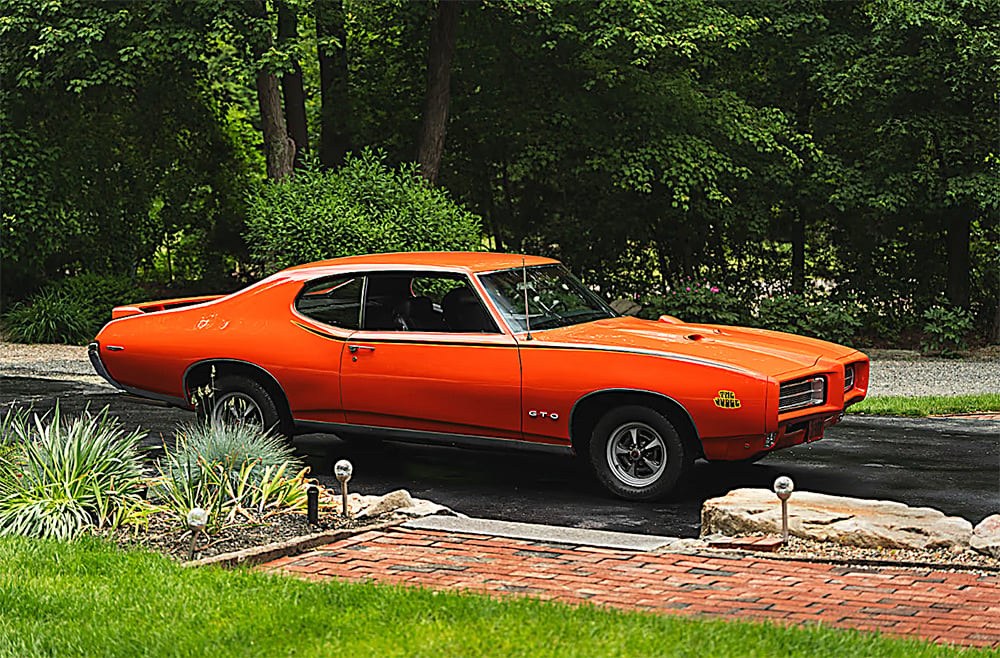
Above and below photos: The following images are of a 1969 Pontiac GTO Judge that was a barn find and restored to an epic, above reproach and judgment condition (photos courtesy of Mecum Auctions). Specifically, here are the highlights:
- Frame-off nut and bolt restoration with 300 miles since completion
- Barn find
- Matching numbers Ram Air III 400 CI V-8 engine
- 4-speed manual transmission
- Rebuilt drivetrain
- Positraction rear end
- Front disc brakes
- PHS documents
- Restoration photos

The History of the GTO Judge
By the time the 1969 model year arrived, Pontiac's GTO had already done more than almost any other automobile to establish the muscle-car formula: put a big engine in a relatively affordable intermediate, give it an aggressive personality, and let performance sell the car.
But the market Pontiac had helped create was changing fast.

Plymouth had the inexpensive and flamboyant Road Runner. Dodge was pushing increasingly outrageous performance cars. Chevrolet, Oldsmobile, Buick, Ford, and Mercury were all fighting for attention in a market where horsepower alone was no longer enough.
Pontiac's response was anything but subtle.
It called the car The Judge.
Announced in December 1968 and introduced during the 1969 model year, The Judge wasn't a separate GTO model in the conventional sense. It was an option package that combined serious Ram Air performance with unmistakable graphics, a rear spoiler, Rally II wheels, and some of the loudest visual treatment Pontiac had yet put on a production automobile.

The name came from the popular "Here Come de Judge" routine heard on Rowan & Martin's Laugh-In, giving Pontiac's new muscle machine an instantly recognizable connection to late-1960s pop culture.
Above: The Judge name was a nod to the sketch comedy character of the same name, famously played by Sammy Davis Jr. The routine was so popular that it also inspired a Baskin Robbins ice cream flavor called "Here Comes the Fudge."
What began as an effort to inject new excitement into the GTO ultimately became something larger. Today, the Judge is arguably the most recognizable GTO of the entire muscle-car era.
And Pontiac built only 11,004 of them.

Pontiac GTO Judge Production Numbers
|
Model Year |
Hardtop |
Convertible |
Total Judge Production |
|
1969 |
6,725 |
108 |
6,833 |
|
1970 |
3,629 |
168 |
3,797 |
|
1971 |
357 |
17 |
374 |
|
Total |
10,711 |
293 |
11,004 |
Those numbers tell much of the Judge story by themselves.
More than 62 percent of all Judges were built during the first model year. Production fell dramatically in 1970 and then collapsed in 1971, when Pontiac discontinued the package early in the model year.
Only 293 Judge convertibles were produced across all three years.
The rarest year was 1971, with just 374 Judges—357 hardtops and 17 convertibles.
1969: Here Comes the Judge
 Above and several below: Your eyes may well be mesmerized by this 1969 Pontiac GTO Judge convertible that's one-of-three produced in Starlight Black (photos courtesy of Mecum Auctions). The highlights of this stealth road burner are below:
- One of 79 Ram Air III 4-speed Judge Convertibles produced in 1969
- One of three known examples in Triple Black
- Concours level frame-off restoration
- Factory 400/366 HP Ram Air III engine
- Accompanied by PHS documentation
- Factory Muncie 4-speed transmission
- Optional hideaway headlights
- Safe-T-Track differential
- Power steering
- Power disc brakes

The original Judge was conceived during an era when Detroit's manufacturers were discovering that performance cars could sell on personality as effectively as horsepower.
Pontiac initially gave The Judge exactly that.
Early cars were heavily associated with Carousel Red, a bright orange-red color that became virtually synonymous with the 1969 Judge. Approximately the first 2,000 Judges were finished in Carousel Red before Pontiac broadened availability to additional exterior colors.

The visual package was impossible to miss.
"The Judge" graphics appeared on the front fenders, while multi-colored striping ran along the body. A pedestal-mounted rear airfoil transformed the GTO's profile. Rally II wheels were fitted without their normal trim rings, reinforcing the purposeful appearance. The interior featured a Judge emblem on the glove box.
But The Judge was not simply an appearance package.
Under the hood was Pontiac's Ram Air performance hardware.

1969 GTO Judge Engines
The standard Judge engine was the 400-cubic-inch Ram Air III V8, rated at 366 gross horsepower.
The optional step upward was the formidable Ram Air IV 400; factory rated at 370 gross horsepower.
|
1969 Judge Engine |
Displacement |
Advertised Horsepower |
Status |
|
Ram Air III V8 |
400 cu. in. |
366 hp |
Standard |
|
Ram Air IV V8 |
400 cu. in. |
370 hp |
Optional |

The Ram Air IV's four-horsepower advantage on paper hardly tells the story.
It incorporated round-port cylinder heads, a more aggressive camshaft, freer-flowing induction and exhaust components, and other hardware aimed at high-rpm performance. Pontiac's advertised ratings were produced during an era in which horsepower figures were as much a product-planning consideration as an engineering measurement.
The Ram Air IV therefore became one of the most coveted Pontiac engines of the muscle-car period.
Transmission choices included manual gearboxes and Pontiac's Turbo Hydra-Matic automatic, depending upon engine and configuration.
1969 GTO Judge Production
Pontiac produced:
6,725 Judge hardtops
108 Judge convertibles
6,833 Judges total
The convertible represented less than two percent of Judge production that year.

That rarity becomes even more pronounced when examining certain Ram Air IV combinations. However, enthusiasts should approach extremely specific "one-of-X" claims carefully. Pontiac documentation does not provide a complete factory breakdown for every conceivable Judge combination, and figures repeated in auction descriptions or enthusiast literature are not necessarily factory-documented production totals.
For restorers and buyers, documentation of the individual vehicle is therefore more valuable than an unsupported rarity claim.
1970: The Judge Matures

Above and several below: You can appreciate the refined styling of the 1970 Pontiac GTO Judge in the following photos (photos courtesy of Mecum Auctions). Some of the highlights of this Judge are below:
- Documented Ram Air IV GTO Judge
- 1 of 325 Ram Air IV Judges with manual transmission in 1970
- Original build sheet
- PHS documents
- Frame-off nut and bolt restoration
- Original sheet metal
- 400/370 HP Ram Air IV engine
- 4-barrel carburetor
- Close ratio 4-speed transmission
- Safe-T-Track differential
- 3.90 gears
- Power steering
- Ride and handling package
- Polar White with Red interior
- Bucket seats
- Soft Ray tinted glass
- Hood tachometer
- Pushbutton AM radio
- Rally gauge cluster
- Remote trunk lid release
- Goodyear polyglass tires

Pontiac substantially restyled the GTO for 1970.
The four exposed headlamps remained, but the previous year's Endura front end gave way to a more sculpted design with prominent vertical grille openings. The result was muscular and unmistakably Pontiac.
The Judge package returned with revised striping, graphics, rear spoiler, Rally II wheels without trim rings, and Ram Air performance.
1970 GTO Judge Engines
The standard engine remained the 400 Ram Air III, again rated at 366 horsepower, while the 370-horsepower Ram Air IV remained optional.

|
1970 Judge Engine |
Displacement |
Advertised Horsepower |
Status |
|
Ram Air III V8 |
400 cu. in. |
366 hp |
Standard |
|
Ram Air IV V8 |
400 cu. in. |
370 hp |
Optional |
Pontiac also offered a 455 in the regular 1970 GTO line, but this point can cause confusion when discussing Judges: the 1970 Judge remained fundamentally a Ram Air 400 proposition. Contemporary production information identifies the Ram Air III and Ram Air IV as the Judge powerplants.
The Judge option itself added approximately $337 to the price of a 1970 GTO. That's equivalent to just under $3,000 in today's money.

1970 Judge Production
Production dropped sharply:
3,629 hardtops
168 convertibles
3,797 total
Interestingly, convertible Judge production increased from 108 to 168 even as overall Judge production declined.
That makes 1970 the highest-production year for Judge convertibles—but 168 cars still constitute an exceptionally small population.

Ram Air IV examples sit near the top of today's Judge hierarchy. Extremely low production figures are frequently attached to particular transmission and body-style combinations, especially Ram Air IV convertibles. Because surviving historical records don't necessarily document every Judge-specific subset independently, collectors should distinguish between established Pontiac production records and numbers reconstructed later from registries, known cars, or broader GTO engine totals.

1971: The Final Judgment

Above and several below: A Lucerne Blue with blue interior 1971 Pontiac GTO Judge has the 455 cubic inch high output big block V8 and is backed by a Muncie four-speed manual transmission (photos courtesy of Mecum Auctions). Nice! You'll find more of the details below:
- MCACN Concours Gold winner in 2024
- Build sheet
- Highly desirable code 26 Lucerne Blue with Blue interior
- WC-code H.O. 455 CI V-8 engine
- HD 12-bolt Safe-T-Track differential
- 1 of 4 very early production Judges known to have been made almost identically, likely for promotional purposes
- Last year for the Judge with 357 produced
- 1 of only 195 produced with the 4-speed manual
- No-expense-spared engine rebuild
- Balanced and blueprinted
- Forged connecting rods and pistons
- Restoration completed in the fall of 2024
- The best original parts along with many NOS parts were used during the restoration
Everything changed for 1971.

Increasing insurance costs, tightening emissions requirements, changing horsepower standards, and shifting buyer preferences were rapidly transforming Detroit's performance market.
Pontiac nevertheless gave the GTO another dramatic redesign.

The 1971 GTO received a prominent twin-grille front end, revised hood treatment, and a more aggressive interpretation of Pontiac's Endura styling.

The Judge returned—but barely.
Production of the Judge package ended in February 1971, making the final version a particularly short-lived automobile. Only 374 were built.
There was also a major mechanical change.
455 H.O.: The Final Judge Engine
Every 1971 Judge received Pontiac's 455 H.O. V8.
The famous Ram Air III and Ram Air IV engines were gone. The 455 H.O. used serious performance hardware including round-port cylinder heads and an aluminum intake manifold, while the Judge retained functional hood induction.
|
1971 Judge Engine |
Displacement |
Advertised Output |
Status |
|
455 H.O. V8 |
455 cu. in. |
335 hp gross |
Standard |

The 455 H.O.'s character differed from that of the high-winding Ram Air IV. Its larger displacement delivered the kind of broad torque that made Pontiac's big-cube engines formidable street performers.
Transmission choices included a three-speed manual, four-speed manual, and automatic.
1971 Judge Production
The final numbers were extraordinary:
357 hardtops
17 convertibles
374 total

That means fewer 1971 Judges were produced in total than Pontiac had built during many individual weeks of GTO production earlier in the muscle-car era.
And the convertible is in another category entirely.
Only 17 1971 Judge convertibles were produced. Hemmings reports that just three of those cars were equipped with the M22 four-speed.
Whether measured by production volume, historical importance, or visual impact, a genuine 1971 Judge convertible therefore ranks among the ultimate Pontiac collectibles.

Above: One-of-two 1971 Pontiac GTO Judge convertibles in Tropical Lime. Note the presence of the optional Honeycomb wheels, which were also available on the 1971 Trans Am. (photo courtesy of Mecum Auctions)
Engine Overview: Three Years of Judge Power
The progression of Judge engines provides a concise view of Pontiac performance at the end of the classic muscle-car era.
|
Engine |
1969 |
1970 |
1971 |
|
400 Ram Air III, 366 hp |
Standard |
Standard |
— |
|
400 Ram Air IV, 370 hp |
Optional |
Optional |
— |
|
455 H.O., 335 hp gross |
— |
— |
Standard |

Above and below: 1969 Pontiac GTO Judge in Liberty Blue equipped with its 400 Ram Air III, 366-horsepower V8 and four-speed manual Muncie transmission (photos courtesy of Mecum Auctions).

One caution is essential when comparing these ratings.
The horsepower numbers belong to the gross-horsepower era and should not be compared directly with modern SAE net ratings. Changes in compression ratios, emissions requirements, testing procedures, and engine specifications also make simple year-to-year horsepower comparisons misleading.
What matters historically is that Pontiac ensured every production Judge received a genuinely high-performance engine.

Above and below: The image above must be from a drone - a 1970 Pontiac GTO Judge convertible that's equipped with the 370-horsepower, 400 Ram Air IV V8 optional mill and an automatic transmission. Only seven were equipped this way. This Judge sold for $1.1 million at the 2023 Kissimmee, Florida Mecum Auction (photos courtesy of Mecum).

The stripes and spoiler attracted attention.
The engine made the name credible.
Spotting a Judge at a Glance

Above: 1969 Pontiac GTO Judge Ram Air IV with Muncie four-speed manual Pontiac factory backed D/Stock drag racing car, Arnie 'The Farmer' Beswick owner/driver (photo courtesy of Mecum Auctions)
Exact equipment and details changed during the three-year production run, but several features became synonymous with the package.
Depending on year, Judge equipment included distinctive "The Judge" decals and striping, a rear deck spoiler, Ram Air or functional hood induction, performance-oriented engine equipment, and distinctive wheel treatment.
The graphics evolved considerably. The earliest 1969 cars established the flamboyant look, while subsequent versions received revised stripe patterns and colors. By 1971, the graphics arched dramatically over the wheel openings, giving the final Judge an appearance unlike either predecessor.
Rally II wheels without trim rings became another familiar Judge visual cue. For 1971, Pontiac's new Honeycomb wheels were also available as an option.
These differences matter enormously during restoration. A stripe kit, spoiler, hood, or engine that is correct for one model year may be incorrect for another.
How Rare Is a Pontiac GTO Judge?

Above: 1969 Pontiac GTO Judge nose - no optional hideaway headlights on this tarmac terrorizer (photo courtesy of Mecum Auctions).
The answer depends heavily on the year.
Of the 11,004 total Judges, roughly 62 percent were 1969 models. Another 34.5 percent were built for 1970.
Only about 3.4 percent were 1971 models.
Convertibles are considerably scarcer:
|
Year |
Judge Convertibles |
|
1969 |
108 |
|
1970 |
168 |
|
1971 |
17 |
|
Total |
293 |
Thus, fewer than 300 Judge convertibles were produced during the entire three-year run.
But production rarity should not be confused with survival rate.
Not every Judge survives today, and surviving examples vary dramatically in originality, condition, documentation, and configuration. Conversely, because Judges have long been desirable, many ordinary GTOs have been cosmetically converted into Judge lookalikes.
That's why documentation matters.
How to Identify a Real GTO Judge

Above: 1970 Pontiac GTO Judge convertible rear spoiler (another Mecum Auctions photo - thanks Mecum!)
A spoiler and a set of Judge decals prove very little.
The Judge was an option package, which means identification requires more care than simply decoding the basic body style from the VIN. For anyone considering the purchase or restoration of a purported Judge, historical documentation should be a priority.
Pontiac Historical Services (PHS) documentation has become particularly important in the Pontiac hobby because factory invoicing information can establish how an individual vehicle was originally equipped.
Collectors should also examine the engine and drivetrain identification, casting dates, assembly dates, body information, trim tag, original colors, and physical evidence on the vehicle.
The objective isn't merely to determine whether the car looks like a Judge.
It's to establish what Pontiac actually built.
That distinction becomes increasingly important as values rise—and especially when a seller describes a car using extremely specific rarity claims.
Judge Production Versus GTO Production

Above and below: Having the documentation from the Pontiac Historical Services helps you to prove your case (we're talking evidence) that your 1969 Pontiac GTO Judge is indeed a Judge. In this particular case, it's a 1969 Pontiac GTO Judge convertible, one-of-three in Starlight Black (photos courtesy of Mecum Auctions).

The Judge's fame can make it seem as though the special package dominated GTO sales.
It didn't.
Judge production was a relatively small fraction of overall GTO output, particularly as the muscle-car market contracted.
By 1971, total GTO production had fallen dramatically, and Judge production was down to only 374 units. The decline wasn't evidence that Pontiac had forgotten how to build performance cars. It reflected a market undergoing fundamental change.
Insurance premiums were rising.
Emissions requirements were tightening.
Compression ratios were coming down.
Fuel considerations were becoming increasingly important.
And the young buyers who had fueled the original muscle-car boom were encountering an increasingly hostile environment for high-horsepower automobiles.
The Judge arrived near the peak of the horsepower race and disappeared as that era began to close.
Its timing is part of what makes it historically significant.
11,004 Cars and One Lasting Legacy

Above: 1970 Pontiac GTO Judge convertible (photo courtesy of Mecum Auctions)
Pontiac didn't need decades to turn The Judge into an icon.
It needed three model years.
The 1969 version established the formula: outrageous graphics, a spoiler, Ram Air power, and a name no enthusiast could forget.
The 1970 Judge refined the idea while preserving the Ram Air III and fearsome Ram Air IV.
And the 1971 model closed the story with the 455 H.O.—just 374 cars before Pontiac lowered the gavel.
Today, each version represents a different moment in the evolution of the American muscle car.
The 1969 Judge captures the exuberance of the late 1960s.
The 1970 model represents Pontiac performance near its mature peak.
The exceptionally scarce 1971 Judge represents the end of an era.
That's why The Judge remains much more than a special GTO with colorful stripes.
It represents Pontiac at its boldest: a company willing to combine legitimate performance engineering with humor, attitude, color, and enough visual excess to make sure nobody mistook its newest muscle car for anything else.
More than half a century later, the verdict is in.
The Judge still rules.

Above: 1969 Pontiac GTO Judge coupe - 'judge not lest ye be judged' (photo courtesy of Mecum Auctions).
Pontiac GTO Judge Quick Reference Guide
Production years: 1969-1971
Total production: 11,004
Hardtops: 10,711
Convertibles: 293
Highest-production year: 1969 — 6,833
Lowest-production year: 1971 — 374
Rarest Judge body-style/year combination: 1971 convertible — 17 produced
1969 standard engine: 400 Ram Air III — 366 hp
1969 optional performance engine: 400 Ram Air IV — 370 hp
1970 standard engine: 400 Ram Air III — 366 hp
1970 optional performance engine: 400 Ram Air IV — 370 hp
1971 Judge engine: 455 H.O. — 335 gross hp
Total Judge convertible production, all years: 293
Production Data Note
Pontiac production records establish overall Judge totals and many important body-style and powertrain figures, but they do not necessarily provide a Judge-specific breakdown for every possible combination of engine, transmission, color, options, and body style. Consequently, extremely specific "one of X" claims found in auction catalogs, advertisements, registries, and enthusiast literature should be evaluated against original documentation rather than automatically treated as factory-established production figures.
Classic Industries - Your Place for Finding GTO Parts
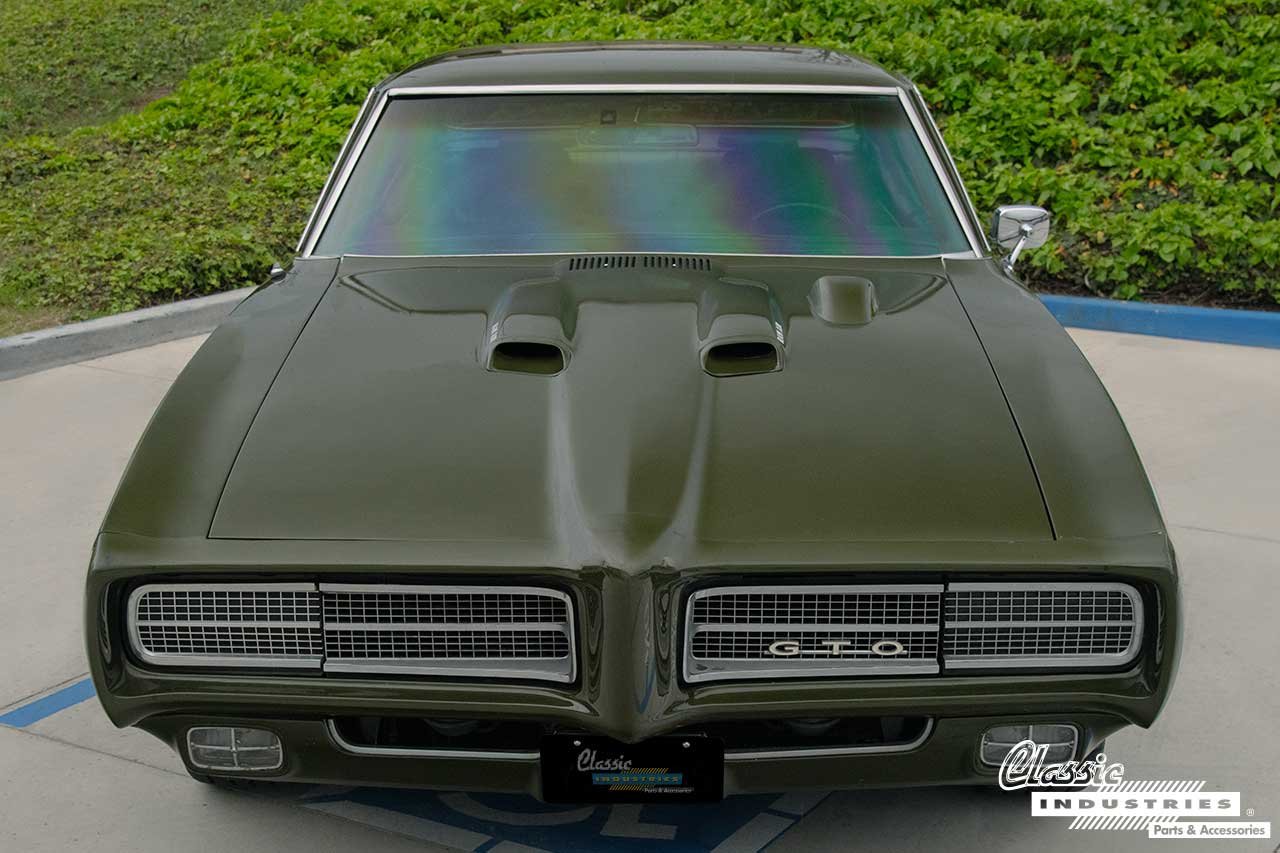
Classic Industries offers a vast array of components and accessories for the American muscle car hobby. Whether you rock a Pontiac, shine in a Chevy, roll strong in a Ford, or race a Mopar, you can seek parts on the Classic Industries website. Pontiac GTO owners will be pleased to hear that CI recently added a full line of 1964-73 Pontiac GTO components!