


Big improvements don't always require big bucks. These five budget-friendly upgrades can make your classic Mustang look better, feel better, and become even more enjoyable to drive.
There's something magical about sliding behind the wheel of a first-generation Ford Mustang, twisting the ignition key, and hearing that familiar engine rumble to life. Whether your pony car packs a thrifty 200-cubic-inch inline-six, a spirited 289 small-block, a 351 Cleveland, or a thundering 428 Cobra Jet, the experience is pure automotive Americana.

Ford struck gold when it introduced the Mustang on April 17, 1964. With its long hood, short rear deck, sporty bucket seats, and seemingly endless combinations of engines, transmissions, colors, and options, the Mustang helped launch an entirely new automotive category: the pony car.
More than six decades later, those original Mustangs continue to captivate collectors, restorers, weekend cruisers, and everyday gearheads.
Of course, owning a classic Mustang comes with its share of challenges. After 50-plus years of service, rubber deteriorates, electrical components become temperamental, interior trim shows its age, and everyday wear takes a toll. Fortunately, you don't need a five-figure restoration budget to make meaningful improvements.
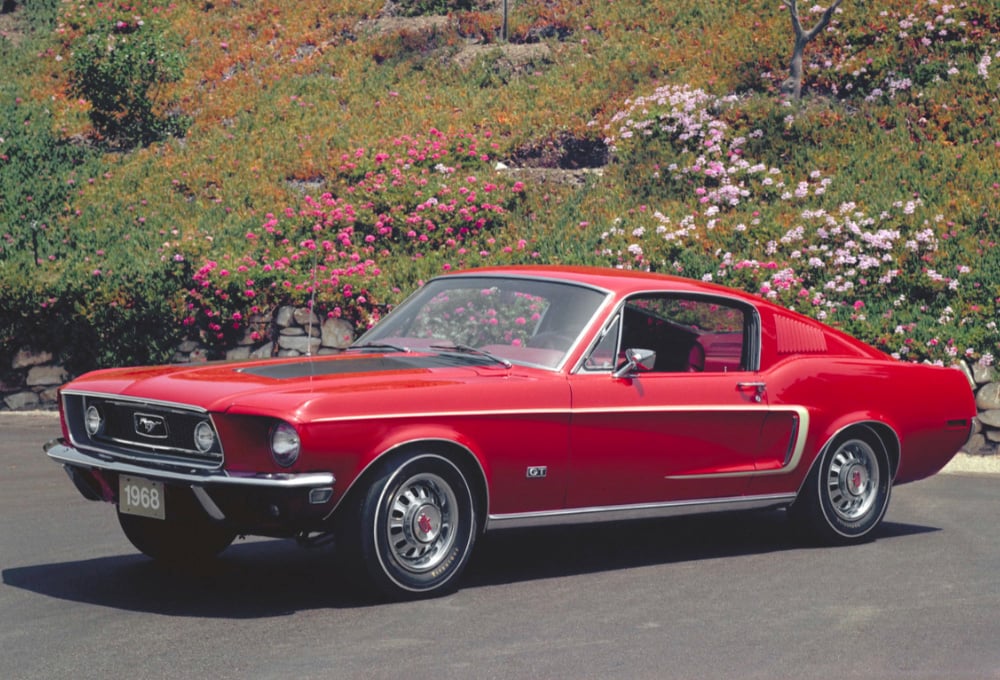
Above: Archival photo of 1968 Mustang fastback GT (photo courtesy of Ford Heritage Vault). The lead photo is of a 1967 Ford Mustang GT390 convertible (photo courtesy of Mecum Auctions).
Sometimes, a relatively inexpensive replacement part and a couple of hours in the garage can make your Mustang feel years younger.
With that in mind, we've assembled five affordable upgrades worth considering for your 1964½–1973 Ford Mustang. Each addresses a common concern, and the necessary components can be found through Classic Industries.
So, grab your favorite beverage, roll up those sleeves, and prepare to give your pony car some well-deserved attention.
1. Replace Worn Weatherstripping: Keep the Weather Outside Where It Belongs

Above: 1967 Shelby Mustang GT500 with inboard driving lights, which indicates it's an early production 1967 Shelby (photo courtesy of Mecum Auctions)
Few things can spoil an otherwise enjoyable Sunday cruise faster than wind whistling around the doors, water finding its way onto the carpeting, or excessive road noise interrupting the music of your Mustang's engine.
When Ford assembled these cars, fresh rubber weatherstripping helped seal the passenger compartment against the elements. Unfortunately, decades of exposure to sunlight, temperature fluctuations, and ordinary wear can turn once-flexible rubber into brittle, cracked, or flattened material.
If your Mustang's doors rattle, rainwater enters the cabin, or you notice excessive wind noise at highway speeds, deteriorated weatherstripping could be part of the problem.
Fortunately, replacing worn door seals is one of the more approachable improvements a home mechanic can undertake.
Why it's worth the investment
Fresh weatherstripping offers several advantages beyond keeping your socks dry.
- Better weather protection: Helps prevent rainwater, dirt, and moisture from entering the passenger compartment.
- Reduced wind noise: Properly fitted seals can make highway cruising more pleasant.
- Interior preservation: Helps protect carpeting, floor pans, and interior trim from moisture damage.
- Improved fit and finish: Replacing flattened seals can help restore proper sealing around the doors.
Installation generally involves removing the deteriorated seals, cleaning away the old adhesive, and installing the replacements according to the manufacturer's instructions.
Take your time removing the old material. A plastic scraper and an appropriate adhesive remover can make the job easier without damaging the surrounding paint.
One important consideration: New weatherstripping can initially make the doors more difficult to close until the rubber compresses and settles into place. Don't immediately start adjusting door hinges or strikers to compensate.
Classic Industries product spotlight

1967–1968 Mustang Premium Door Frame Weatherstrips — Part #20530DE
This American-made reproduction set includes left- and right-hand door seals and installation hardware. The extruded rubber is designed to replace the original doorframe weatherstripping and help keep moisture, dirt, and road noise outside the vehicle.
Shop Part #20530DE at Classic Industries.
Owners of other first-generation Mustangs can find year-specific weatherstripping through the Classic Industries Mustang parts selection.
Garage tip: Before replacing your seals, inspect the door alignment, window adjustment, and drain openings. Even brand-new rubber won't compensate for a poorly aligned door or blocked drainage.
A quieter, drier Mustang is a happier Mustang—and so is its owner.
2. Brighten Up Your Instrument Panel with LED Lighting
Picture this: You're cruising along a favorite two-lane highway just after sunset. Your Mustang's small-block V8 is humming contentedly, the windows are down, and the evening air feels terrific.
There's just one problem. You can barely read the speedometer!
If your Mustang still relies on its original-style incandescent instrument lighting, you're probably familiar with the soft, sometimes disappointingly dim glow of a vintage Ford dashboard.
While that subdued illumination contributes to the car's nostalgic personality, aging bulbs, dirty lenses, deteriorated electrical connections, and tired wiring can make nighttime gauge visibility less than ideal.
One relatively inexpensive solution is to install LED instrument-panel bulbs designed for your Mustang's particular gauge cluster.
A little more light goes a long way
LED bulbs offer several benefits compared with traditional incandescent lighting.
- Improved visibility: Brighter illumination can make speedometer markings and other gauges easier to read after dark.
- Reduced electrical consumption: LEDs generally require less current than comparable incandescent bulbs.
- Long service life: Quality LED bulbs typically outlast conventional incandescent bulbs.
- Color choices: Depending on the kit, enthusiasts can select traditional-looking white illumination or other colors.
For Mustang owners who prefer an original-looking interior, white or green illumination may be especially appealing. Those who favor a more personalized restomod appearance might prefer blue or another available color.
The beauty of this improvement is that the dashboard doesn't necessarily need to look dramatically different during daylight hours.
The real payoff arrives when the sun goes down.
Classic Industries product spotlight

1964½–1970 Mustang LED Instrument Bulb Kits
Classic Industries' Mustang catalog has listed instrument lighting kits for different early Mustang gauge configurations, including five-gauge instrument clusters and earlier warning-light arrangements.
One example is Part #13466X, a white LED bulb kit listed for early Mustangs with the standard warning-light instrument arrangement. Other versions are available for different gauge layouts and illumination colors.

Shop Part #13466X at Classic Industries.
Garage tip: Before ordering LED bulbs, check your instrument-panel ground connections, headlight switch, and dimmer circuit. Some LEDs do not dim like conventional bulbs, and turn-signal indicators may require polarity-sensitive installation.
While the instrument cluster is apart, consider carefully cleaning the lenses and checking the condition of the printed circuit, wiring connections, and bulb sockets.
You'll be surprised how much more inviting an illuminated vintage dashboard can look.
3. Replace Worn Pedal Pads: Small Parts, Big Improvement

Above: 1969 Mustang Mach 1 showing fuel pedal and clutch pedal pads (photo courtesy of Mecum Auctions)
Sometimes, the most satisfying automotive improvements are the ones that cost less than a tank of gasoline.
Consider your Mustang's brake, clutch, and accelerator pedal pads.
They're hardly glamorous components. Nobody attends a car show hoping to photograph an original brake pedal pad. Nevertheless, these hardworking pieces of rubber are among the most frequently used parts in your Mustang's interior.
Every time you accelerate, shift gears, or apply the brakes, your feet interact with these components.
After decades of service, the original pads may be worn smooth, cracked, hardened, or missing altogether.
Not only do tired pedal pads make an otherwise attractive interior look neglected, but deteriorated rubber can also reduce the traction between your shoes and the pedals.
That's not something you want when approaching a busy intersection in a 1966 Mustang GT.
Restore the factory appearance
Replacing worn pedal pads can deliver three immediate benefits: improved foot traction, a cleaner interior appearance, and a more comfortable driving experience.
Original-style replacements are particularly appealing to owners who appreciate the Mustang's factory-correct details.
Ford's designers gave considerable attention to the appearance and texture of the Mustang's interior controls. Correctly styled rubber pedal pads help preserve that authentic character.
And unlike replacing an entire interior, installing new pedal pads generally requires minimal disassembly.
Depending on the design, the old rubber cover can be removed and the replacement fitted over the pedal's metal backing.
Make certain the new pad is fully seated and cannot slip off during operation.
Classic Industries product spotlight

1964–1972 Ford/Mercury Accelerator Pedal Pad with Stainless Steel Trim — Part #9735A
This reproduction accelerator pedal pad features factory-style ribbing, grip, and polished stainless-steel trim. It replaces Ford part number C5ZZ-9735-D for applicable vehicles.
Shop OER Authorized Part #9735A at Classic Industries.
For manual-transmission Mustangs, another affordable example is Part #7A624A, an original-style molded rubber clutch pedal pad listed for various 1965–1971 Ford and Mercury applications, including early Mustangs.

Shop Part #7A624A at Classic Industries.
Garage tip: While you're working in the footwell, inspect the pedal pivot bushings, clutch linkage, return springs, and brake-light switch. Excessive pedal movement, binding, or looseness may indicate problems beyond worn rubber covers.
A fresh set of pedal pads won't add horsepower, but they can make every mile behind the wheel a little more enjoyable.
And isn't that what owning a classic Mustang is all about?
4. Dress Up the Engine Compartment with Factory-Style Decals

Above: Part #FD5001
Pop the hood of a beautifully restored first-generation Mustang and you'll discover something interesting. The most impressive engine compartments aren't necessarily the ones overflowing with chrome-plated accessories and polished aluminum.
Sometimes, the most appealing engine bays are those that look just as they did when the car rolled off Ford's assembly line.
A properly painted engine, clean valve covers, neatly routed spark-plug wires, and factory-style decals can make a tremendous visual difference.
Best of all, those finishing touches don't have to cost a fortune.
Over the years, engine-compartment decals become faded, discolored, damaged, or simply disappear during repairs and repainting.
Replacing them is one of the easiest and most affordable ways to restore some of your Mustang's original showroom character.
The little details make the difference

Above: Part #FD5012
Ford used numerous identification, maintenance, and service decals throughout the first-generation Mustang's production run.
Depending on the model year, engine, and equipment, these included air-cleaner identification decals, oil-filter service labels, engine tune-up information, and other under hood markings.
Reproducing these details can make a particularly satisfying weekend project.
For example, a freshly restored 1965 Mustang with a 289 V8 looks even more convincing when the correct service and identification decals accompany its factory-style engine finishes.
These details are also worth considering if you participate in Mustang club shows or judged concours events.

Above: Part #FD5009
Of course, authenticity matters. A decal that belongs on a 1966 Mustang isn't necessarily appropriate for a 1970 Boss 302.
Consult a factory assembly manual or reliable restoration reference before installing anything.
Classic Industries product spotlight
Classic Industries offers several inexpensive reproduction decals for early Mustangs, including:
|
Part number |
Description |
|
FD5001 |
1965–1966 Mustang service specification decal |
|
FD5012 |
1964–1970 Mustang Rotunda 6,000-mile oil-filter decal |
|
FD5009 |
1965–1967 Mustang oil-cap decal |
|
FD5086 |
1964–1966 Mustang fuel-pump filter decal |
These decals reproduce original-style lettering, colors, and service information.
Shop Part #FD5001 · Shop Part #FD5012 · Shop Part #FD5009 · Shop Part #FD5086

Above: Part #FD5086
Garage tip: Thoroughly clean the mounting surface before applying decals. Make sure the surface is dry, free of wax or grease, and at an appropriate temperature for adhesion. Use factory references to determine the correct locations.
A few dollars spent on authentic looking under hood details can make a Mustang's engine compartment appear considerably more finished.
And that's money well spent.
5. Replace Your Mustang's Tired Gas Cap: A Finishing Touch with Plenty of Personality
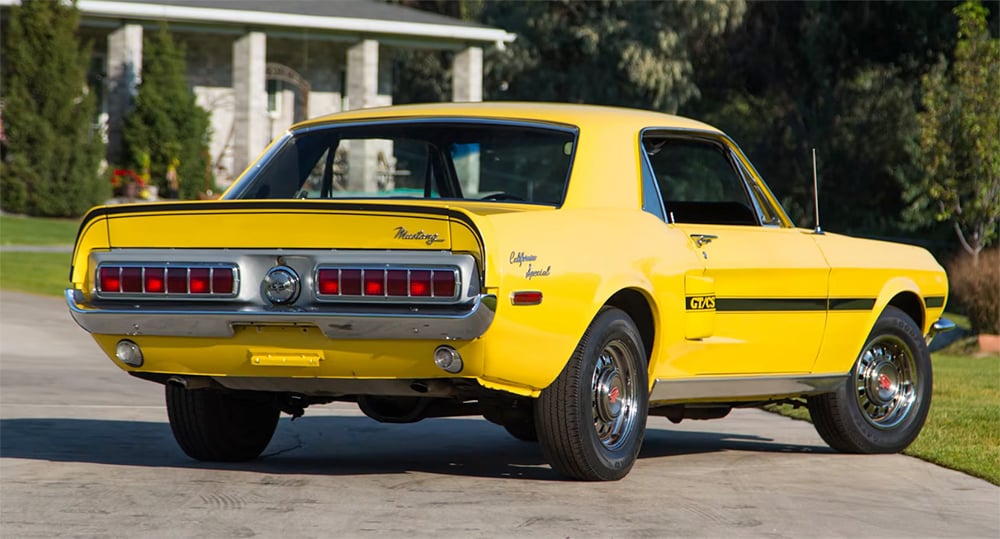
Above: 1968 Mustang GT/CS - GT California Special (photo courtesy of Mecum Auctions)
Here's an upgrade that Mustang enthusiasts sometimes overlook.
Unlike many other automobiles of the era, first-generation Mustangs prominently displayed their fuel caps on the rear body panel.
That location made the gas cap an integral part of the car's styling rather than merely a functional component.
Ford took full advantage of the opportunity, decorating various Mustang fuel caps with the famous running-horse emblem, GT identification, and other distinctive designs.
Unfortunately, after decades of exposure to sunlight, rain, road grime, and countless visits to the gas station, these attractive pieces can begin to look rather tired.
Chrome becomes pitted, painted surfaces fade, and the original decorative details lose their luster.
Even worse, a deteriorated cap seal can allow fuel vapors to escape or compromise the fuel system's intended sealing arrangement.
Replacing a worn fuel cap is a straightforward way to improve your Mustang's rear appearance while addressing a potentially important maintenance concern.
An upgrade you can appreciate immediately
Unlike more complicated restoration projects, replacing a gas cap usually requires little more than removing the old component and installing its replacement.
There's no engine disassembly, no specialized fabrication, and generally no need to put your Mustang out of commission for the weekend.
The visual improvement can be substantial, especially when the new cap complements freshly polished taillight bezels and clean rear-panel trim.
For owners who prefer a stock appearance, a factory-style reproduction is an excellent choice.
Those building a modified Mustang may prefer a custom cap, provided it's compatible with the vehicle's fuel-filler and venting system.
Classic Industries product spotlight

1968 Mustang Standard Running Horse Gas Cap — Part #9030R
This officially licensed Ford reproduction features the familiar running-horse-and-corral emblem, chrome exterior, correct black detailing, and a retaining cable.
Manufactured from zinc die-cast material, it is designed to reproduce the original appearance of the standard 1968 Mustang gas cap.
Shop Part #9030R at Classic Industries
Classic Industries also offers other factory-style and custom gas caps for first-generation Mustangs, including reproduction 1969–1970 running-horse versions and billet aluminum alternatives.
Explore Mustang Fuel Caps at Classic Industries
Garage tip: Before ordering, confirm your Mustang's model year, original cap style, filler-neck configuration, and fuel-system venting requirements. A cap designed for a vented system may not be appropriate for a vehicle requiring a different arrangement.
This is one of those rare restoration improvements that can be completed in minutes yet admired for years.
Five Affordable Upgrades, One Happier Mustang - Courtesy of Classic Industries
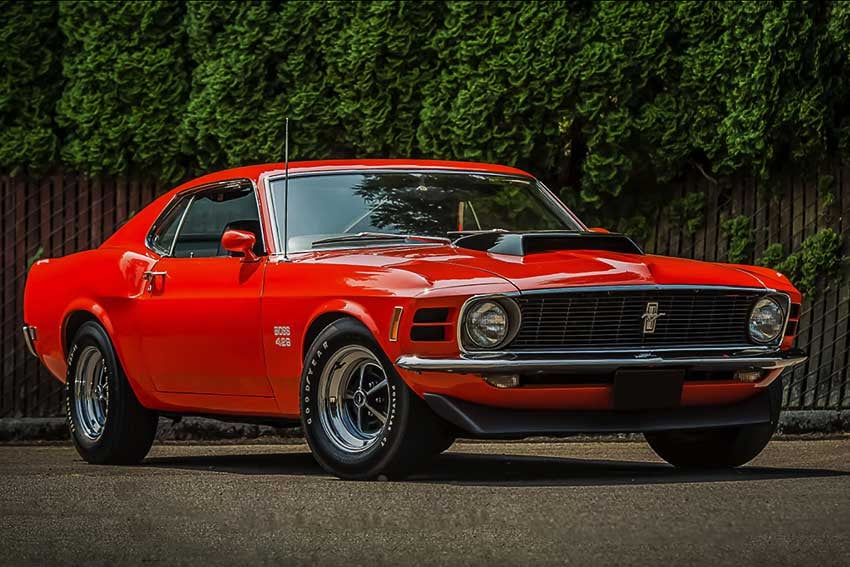
Above: 1969 Boss 429 Mustang in Calypso Coral over black vinyl (photo courtesy of Mecum Auctions)
Restoring and maintaining a first-generation Ford Mustang doesn't always have to involve expensive engine rebuilds, complete suspension overhauls, or months of bodywork.
Sometimes, the greatest satisfaction comes from tackling a handful of manageable projects that make an immediate difference.
Fresh weatherstripping helps protect the passenger compartment. Improved instrument lighting makes nighttime cruising more enjoyable. New pedal pads refresh the driver's footwell. Correct under hood decals restore authentic character. And a handsome replacement gas cap adds a finishing touch to one of America's most recognizable pony cars.
None of these improvements will transform a six-cylinder Mustang into a Shelby GT500, and that's perfectly fine.
After all, the appeal of the original Mustang has never been exclusively about horsepower.
It's about the experience.
It's the distinctive sound of a Ford small-block V8, the view over that long hood, the mechanical feel of a four-speed shifter, and the approving nod from another enthusiast at a stoplight.
Whether your pride and joy is a Wimbledon White 1965 coupe, a Highland Green 1968 fastback, a Grabber Blue 1970 Mach 1, or a beautifully preserved 1973 convertible, a little attention to detail can go a long way.
And with the extensive selection of restoration and performance components available from Classic Industries, keeping your Mustang looking and running its best doesn't have to break the bank.
Explore the Classic Industries First-Generation Mustang Parts Collection or browse the free interactive Mustang Parts and Accessories Catalog for additional restoration inspiration.