

In the world of Mopar muscle, rarity isn’t just about numbers - it’s about the stories buried in sheet metal, the quirks of factory production, and the passion it takes to bring those stories back to life. This 1972 Dodge Demon 340 is one of those stories - a true enthusiast’s car with an uncommon pedigree and a restoration journey driven by equal parts determination and respect for originality.
The car was acquired in August of 2017 from a family friend in northern Idaho - specifically Sand Point, ID. At the time, it was an honest, largely untouched survivor that had yet to undergo restoration. Aside from a few period modifications - an intake and carburetor swap, a repaint, and an altered roof - the car retained much of its original character. But what set it apart wasn’t immediately obvious to the casual observer.
The Significance of Code V3X

Above: Mitchell's car is part of The Mopar Sunroof Registry. According to the online Mopar A-Bodies Only and other online forums, there were 95-ish 340 Demons made with a sunroof. Today, the Sunroof Registry lists six 1972 Demon 340s. Three are orange. The other two Hemi Orange '72 Demons don't have the chrome topped doors like Mitchell's. Instead, they have trunk wings. Could Mr. Valentin's Demon be a one-of-one car? Seems likely to us. The Dodge Demon was only produced for two years, 1971-72. Because of a religious boycott at the time due to the car's satanic name, the Demon sold poorly. Back in the day, a Demon equipped with the 340 V8 (the top engine option for the Demon), the sunroof (a $329 option), and the high level exterior trim package, cost as much as a Dodge Challenger. That's another reason Mitchell's Demon is so rare. More Challengers sold for the same amount of green than Mitchell's Hemi Orange hued, sunroof, and high optioned (and possessed - just kidding) Demon cost.
This Demon was born with a factory-installed sunroof.
Coded “V3X” on the fender tag, the car featured a sunroof system supplied by the American Sunroof Company (ASC) - a rare option that has become a defining detail among Mopar collectors. These early ASC sunroofs were notorious for leaking, and this particular car bore the evidence. At some point in its life, the original owner removed the outer sunroof panel and installed snaps to accommodate a Tonga-style top, likely in an effort to mitigate the persistent water intrusion.
-Apr-06-2026-10-01-55-2184-PM.jpeg?width=640&height=480&name=image1%20(1)-Apr-06-2026-10-01-55-2184-PM.jpeg)
For a Mopar enthusiast, however, that fender tag told the real story. This wasn’t just another Demon - it was a genuine, factory sunroof car. That realization alone made it worth saving.
-Apr-06-2026-10-03-00-8999-PM.jpeg?width=640&height=480&name=image0%20(3)-Apr-06-2026-10-03-00-8999-PM.jpeg)
Vanishing Point Drive South

Above: The 340 V8 mill was rebuilt by Dale Green, who installed an upgraded camshaft, before Mitchell purchased the Dodge. The engine retains its original yet restored exhaust manifolds. The engine block was repainted the original factory B5 blue color. The new owner also replaced the aftermarket intake manifold with a correct: factory intake and thermoquad (Carter four barrel carburetor).
At just 19 years old, the new owner, Mitchell Valentin, made the purchase and immediately put the car to use, embarking on a memorable drive from northern Idaho back to Huntington Beach, California - an experience reminiscent of the open-road spirit captured in the movie that featured a white Dodge Challenger as the hero car - Vanishing Point. Once home, Mitchell's hero Mopar was carefully cleaned, documented, and inspected in detail.

The Mystery of the Broadcast Sheet
During that process, an intriguing discovery surfaced: an original broadcast sheet. But it didn’t belong to this car.

Instead, the sheet corresponded to a blue 340 Demon sunroof car built just days earlier - on a Friday, while this Demon rolled off the line the following Monday. To seasoned Mopar enthusiasts, this isn’t as unusual as it might seem.

The explanation lies in the production process. Much like the well-documented broadcast sheet mix-ups found in Dodge Daytonas and Plymouth Superbirds, cars that required additional post-assembly modifications - such as aero packages or, in this case, sunroof installations - were sent to secondary facilities. There, interiors were removed and later reinstalled, often without strict documentation. As a result, components like broadcast sheets could easily end up in the wrong vehicle, especially among cars built within close proximity on the production schedule.

From Driver to Full Restoration
For a time, the Demon was enjoyed as-is - cruised on weekends and driven around town. But in January of 2018, its trajectory changed abruptly. On the way to a photo shoot, the car was hit by a distracted driver, bringing the driving chapter to an end and forcing a critical decision.

Above and below: The owner's dad is in the printing business. As a result, Mitchell now has a nifty full-color 1972 Dodge Demon build book that chronicles the painstaking restoration process of the Dodge in living color.
Rather than opting for a simple insurance repair, young Mitchell chose a more ambitious path: a full, ground-up restoration.

The car was completely disassembled down to its unibody shell, preserving as much original sheet metal as possible. Special attention was given to returning the sunroof to factory specifications, including repairing the damage left behind by the aftermarket snap-top conversion.

Back to Bare Metal in Idaho
With the car reduced to a bare shell and mounted on a cart, it was transported back to northern Idaho - this time to A10 Autobody, where Mr. Valentin worked alongside his uncle to handle the bodywork. The team meticulously repaired the roof, addressed imperfections, and prepared the car for paint.

Hemi Orange, Done Right
The finish? None other than its original 1972 color: Hemi Orange.
First introduced in 1969 and designated by the “E” in Chrysler’s paint codes, Hemi Orange evolved slightly by 1972 (coded as 1972 EV2 Hemi Orange). While earlier versions featured a heavier metallic flake, the later formulation used a finer metallic - exactly what was applied during this restoration to replicate factory-correct appearance. The result is a finish that captures both the boldness of the era and the subtlety of its later production nuances.

Factory-Correct Details Matter
To complete the exterior, the car wears factory-style vinyl stripes and decals reproduced by Phoenix Graphix, faithfully matching the original layout. The finishing touches include New Old Stock (NOS) emblems specific to the Demon 340 - details that separate a good restoration from a great one.

A Rare Mopar, Preserved
Today, this 1972 Dodge Demon 340 stands as more than just a restored muscle car. It’s a testament to Mopar history, to the quirks of factory production, and to the dedication required to preserve something truly rare. From its ASC-installed sunroof to its correctly finished Hemi Orange paint, every element reflects a commitment to authenticity.

Above: From the factory, Mopar regarded their cars as works of Industrial Art of the highest order. So much so that the engine bay and the trunk were painted the same color as the body. Hence, Mitchell redid the engine bay and the trunk the same color as the body. He also restored the whole trunk and included the undercoating on the inner quarter panel and the original bumper jack.
And like any great Mopar story, it all started with recognizing what others might have overlooked - and refusing to let it fade away.

Classic Industries Has A-Body Mopar Parts (and More)

If you already have a Plymouth Duster, Dodge Demon, or Dodge Dart Sport, or are looking for one, there's a great chance that Classic Industries has the parts that you need to keep it looking great and running strong. You can look for the components you need online by clicking the hotlinks just above. You can also find parts for these and other 1960-76 Mopar models that you might have in our free printed full-color Mopar parts and accessories catalog. Another great tool is the Classic Industries Mopar digital parts and accessories catalog.


More Build Photos of the '72 Demon for Your Enjoyment & Edification (build photos courtesy of the owner)

Above: The chassis' original markings were fastidiously measured and then reproduced in the same font and hue!


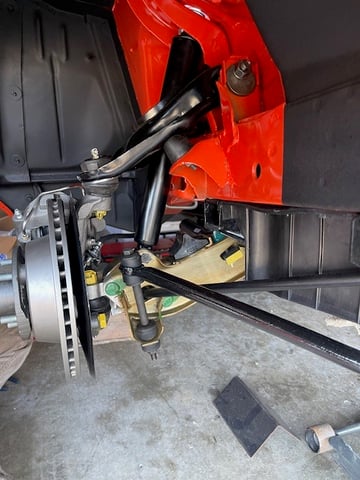

Above: From the factory, the original leaf springs had zinc spacers inbetween the leafs. Pure zinc spacers can no longer be purchased, so Mitchell bought kitchen countertop zinc and had the spacers fabricated to replicate how the leafs were assembled on the Chrysler assembly line.

Above: The lower control arms were originally dipped in cosmoline on the assembly line for rust protection, so Mitchell applied cosmoline to the same line the control arms were dipped in (to) over 50 years ago. On the Hamtramck, New Jersey Mopar assembly line, all the factory bolts, when torqued to the factory specifications received yellow marks. That process was also replicated. You'll notice the suspension parts have orange marks for the driver side and blue markings for the passenger side. Those were also reproduced. Any part that wore black paint on the underside was reproduced that way. Any component left steel or cast iron was painted the proper colors.
-2.jpeg?width=640&height=480&name=image8%20(1)-2.jpeg)
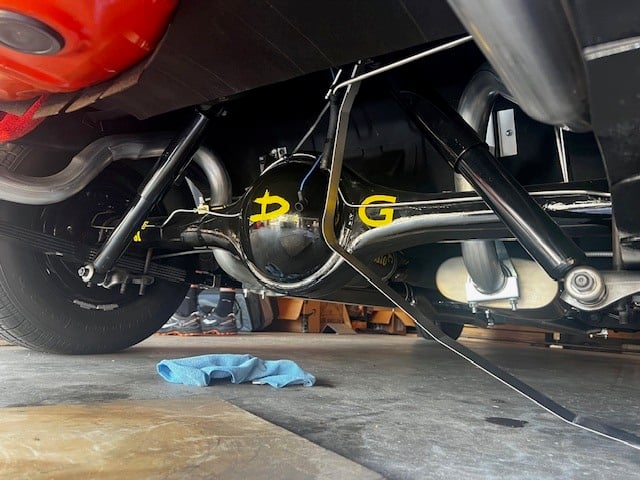
Above: Of course, the numbers-matching (340 cubic inch V8 engine, 727 automatic transmission, sunroof, rear end, original upholstery, and most everything else) Demon still sports its restored 8.25-inch rear end/axle with 3.23:1 final drive ratio gearing, with disc brakes in front and drums in the rear chassis, all as original. Mitchell Valentin gives a huge shout out to his pop's Bernie for passing on his Mopar knowledge and helping him bring the Mopar unicorn back to life. The accolades also go to A-Body Only online forums and the Mopar experts who are always showing up early on Saturday mornings at Donut Derelicts in Huntington Beach, CA, aka Surf City U.S.A.!