

In 1966, the Trans-American Championship racing series was created by the Sports Car Club of America (SCCA). During those early days, manufacturers competed head-to-head with modified versions of their production cars — these included the Ford Mustang, Mercury Cougar, Plymouth Barracuda, Dodge Challenger, Pontiac Firebird (and later the eponymous Trans Am), and of course the Chevrolet Camaro. Competition was fierce, and as is often the case in racing, teams were looking for any advantage they could get. Mark Donohue's Sunoco Camaro Z28 pushed the limits and bent some rules to achieve an incredible winning streak in the 1968 Trans-Am championship.
Photos courtesy of Mecum Auctions
An Unfair Advantage?

Above: Penske Chevrolet teamed up with Sunoco oil to build a fleet of modified 1967 Camaro race cars for the Trans Am series. (Photo by Jim Chipps, Courtesy of SCCA Archives)
Since the Trans-Am series was a relatively new creation, so was its rule book. Engine displacement was limited to 305 cubic inches or 5 liters, and the racecars had to be based on production cars, but other aspects of the rules left room for interpretation (or circumvention).

Above: Ford invested serious money into Trans-Am racecars like this '68 Mustang. Chevrolet realized they had to do the same if they wanted to stay competitive and draw the attention of prospective Camaro buyers.
Weight reduction was one way to improve lap times. Every pound eliminated let the cars accelerate faster, corner sharper, and brake quicker. Ford took inspiration from the aerospace industry and started paying Lockheed Martin to dip its Mustangs in a strong acid solution that made the metal thinner and lighter. Once complete and painted, the acid-dipped cars could look identical to production vehicles but weighed hundreds of pounds less.

After learning about these acid-dipped Mustangs, Roger Penske and his Sunoco Camaro team got to work building six cars that could hold their own against the Fords. The most radical of all was the 1967 Camaro Z28 seen here, dubbed "The Lightweight."
While this is in fact an early-production 1967 car, and one of just 602 Z28s built that year, the exterior was updated to resemble a '68 Camaro.

Each of the Sunoco Camaros was powered by a 302ci V8 built by Traco Engineering. Some sources claim these high-revving race 302s produced as much as 550 horsepower. The Sunoco Camaros also had Corvette disc brakes, 15x8-inch magnesium wheels, 12-bolt Positraction rear ends, and Muncie M-22 manual transmissions.

Taking a note out of Ford's book, Penske's team began acid-dipping its race cars for the 1967 season. Parts of this Camaro's doors and fenders were also "swiss-cheesed" with holes to shave pounds. This reduced weight to approximately 2,600 pounds — 400 less than a new production Z28.

This aggressive weight reduction was so successful that SCCA got suspicious and considered banning "The Lightweight" after the 1967 season, but backed down after driver Mark Donohue pointed out that Ford was doing it first. For the 1968 season, the exterior was updated to resemble a '68 Camaro and the numbers on its doors were swapped with one of the Penske team's full-weight cars, allowing "The Lightweight" to blend in with the pack despite its sneaky modifications.
Penske's full-weight cars were sent to tech inspection twice by SCCA officials, but The Lightweight made it through undetected.

Other special modifications included concealed suspension adjustment points, vacuum-assisted brake piston retractors to allow faster pad swaps, and pressurized oil fill points to make it quicker to top off the oil in the pits.

One of the subtlest tweaks was a modification to the front end sheetmetal to improve aerodynamics at high speed. Hemmings' Cam Benty explained: "While taking care to retain the original factory look of the car as required by the rulebook, Penske engineer Rob Fournier sliced at least an inch out of the radiator core support height. By doing so, he brought down the front sheetmetal, bringing the nose closer to the ground and creating less frontal area, aiding straight-line speed."
The sum of all these modifications led Penske, Donohue, and the Lightweight Sunoco Camaro to absolutely dominate the 1968 Trans-Am series, winning 10 of 13 races and claiming Penske its first Trans-Am championship. Donohue told the full story in his appropriately-named book, The Unfair Advantage.

The original Lightweight '67 Sunoco Camaro was listed in Mecum's Kissimmee 2025 auction, but that auction appears to have ended before the reserve was met. One of the other Sunoco Camaros has been estimated to be worth over 1.4 million dollars.
Looking for Camaro Restoration Parts?
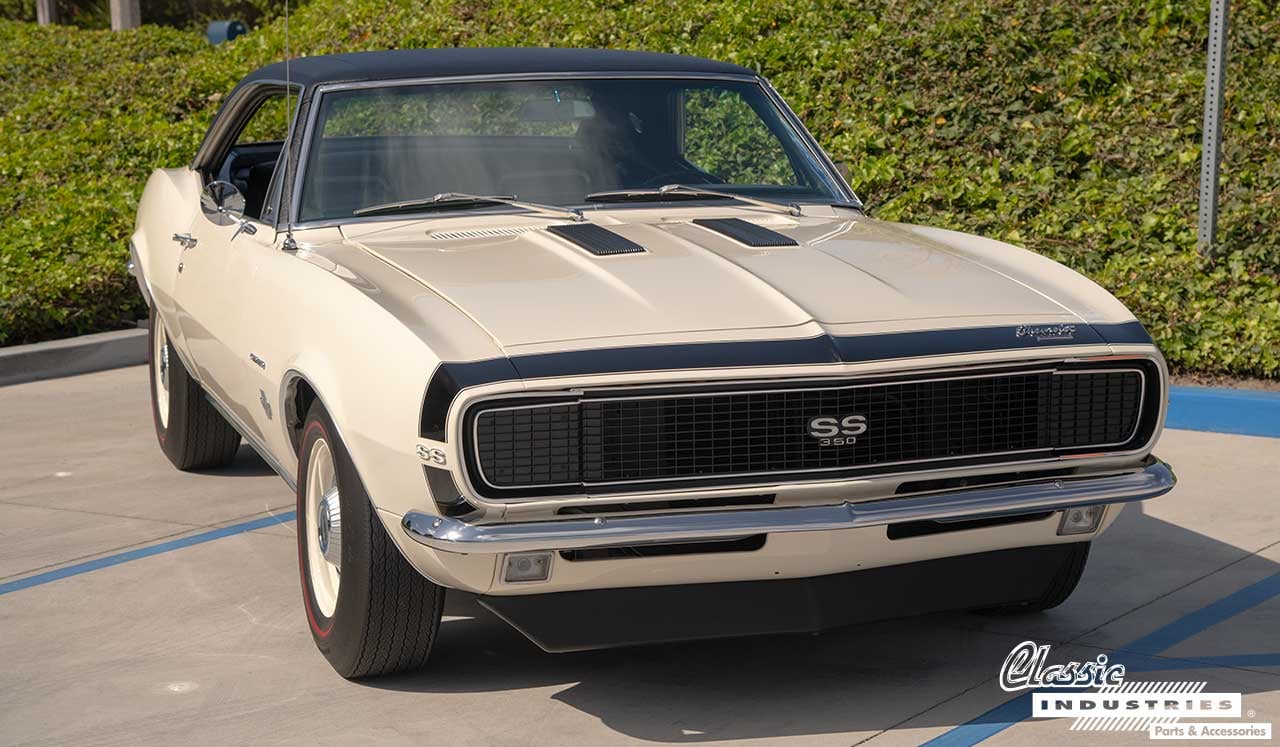
Even though most of us aren't sponsored racecar drivers working to shave tenths of a second off our lap times, we can all enjoy the performance and timeless style of a classic Camaro. If you're working on a restoration or restomod project, click the button below to browse our full selection of 1967-02 Chevrolet Camaro parts.