


Front end components take a terrible beating. Considering highway conditions - pot holes, rough railroad crossings, speed bumps, driveway dips, highway imperfections - it's miraculous that so many older cars are still roaming the roads on their original front end parts. Ball joints and bushings in particular absorb tremendous punishment because they connect the spindles to the control arms and the control arms to the chassis, respectively, actually supporting much of the Camaro's weight as the wheels and tires bounce over highway hazards. But although Camaro front ends have survived the mileage and the years, the damage of time and use eventually takes its toll, usually surfacing as tell-tale pops and squeaks before advancing to the dangerous level.
Front End Replacement

Above: 1967-79 Camaro front end components
By all means, front end replacement should be a required procedure in any full Camaro restoration, unless by chance the front end components have been replaced in the not-toodistant past, in which case the new components can be merely cleaned up and detailed. But with most restoration Camaros, the front end is probably the same one that came with the car some 17 years ago, so replacement falls into the necessity column. After all, what good is a fully restored Camaro if the front end squeaks and pops when you drive it down the road?
Like so many other older Camaros, our project Z/28's original front end had survived some 15 years of pot holes and no telling what other type of typical high performance mistreatment. A quick inspection revealed some damage and wear, but not as much as expected. A visual check of the rubber control arm bushings disclosed minor cracking due to aging, but the sway bar bushings showed signs of serious wear - the top bushings were nearly flat like out-of-round pancakes, which reduces the effectiveness of the sway bar during handling maneuvers. We also spied a pair of coil spring spacers inserted into each front spring, possible remnants from a previous owner's wide wheels and tires. Surprisingly, the high mileage Camaro's ball joints looked fairly good, but to double-check for excessive wear we raised the front end until the wheels were approximately two inches from the ground and pried up on the wheels with a bar. According to the shop manual, the wheels should not move upward more than 1/8-inch. If movement exceeds that specification, then one or both of the ball joints are worn, and final determination must be made visually while the wheel is moved up and down. Due to the distribution of forces within the Camaro's independent front suspension, the lower ball joints usually suffer the most wear and often fail first.

Above: Most OEM replacement front end kits contain new upper and lower ball joints, control arm bushings, tie rod ends, and sway bar bushings. Kits are available from several sources.
Our project Z/28's ball joints fell within the specified tolerances, but since we needed new sway bar bushings and control arm bushings, plus we want our project car to be a completely restored Camaro, including the front end, we elected to renew the Z/28's front with a Camaro front end replacement kit from one of the OEM aftermarket suppliers. Most kits supply upper and lower ball joints, sway bar bushings with new bolts, control arm bushings, and tie rods, plus some kits also include rebound bumpers, lower control arm bushings, and strut rod bushings.
To replace the components of a Camaro front end, the control arms must be removed from the car. This is easily accomplished once the car is disassembled because, without the fenders and wheelwells, the entire front end is exposed. However, due to a magazine deadline, we replaced our project car front end prior to the disassembly, so the accompanying photos depict a front end rebuild with the sheetmetal still intact. Still, the photos show the proper sequence and techniques.
After removing the control arms from the Camaro's front subframe, you can replace the control arm ball joints and bushings in one of two ways: Take the control arms to a Chevrolet service department or a front end shop, or, depending upon your mechanical experience and equipment, replace the joints and bushings yourself. On Camaros, the press-fit control arm bushings and lower ball joints require a hydraulic press for proper removal and replacement without risking damage to the control arm. So, after removing the control arms, take them to a local machine shop for bushing and ball joint replacement.

Above: With the front end sheetmetal removed, the front end components are easily accessible.
Original equipment upper ball joints are riveted in place, so chisel off the rivet heads to remove them and bolt in the replacement upper ball joints. Sway bar bushings and tie rod ends simply unbolt and unscrew for easy replacement.
One word of caution: To remove the control arms, you must also remove the front coil springs. For safety sake, chain the lower control arm to the chassis prior to unbolting the ball joints, thereby preventing the loaded spring from popping out and causing damage - to both you and surrounding property.

Above: 1) After raising the front end of the Camaro and supporting with stands, remove the front wheels to expose the brake drums or disc brake calipers. On a disc brake car like our project Z/28, remove the Allen head caliper bolts. 2) Then, using a large screwdriver, carefully pry the caliper open and lift the caliper from the disc brake rotor.

Above: 3) While the calipers are off, inspect the brake pads and rotors for wear or damage. At this point, disconnect the brake lines and remove the calipers from the car. On older style Camaro calipers, corrosion and rust frequently caused the pistons to stick, so you may want to have your calipers rebuilt, or you can replace the original calipers with stainless steel calipers from one of the aftermarket suppliers. 4) Continuing with the front end disassembly, unbolt the tie rod ends from the spindle.

Above: 5) Force the old tie rod end stud through the spindle with a hammer. If you're replacing the tie rod ends with new units from a front end kit, don't be concerned with preserving the threads on the old tie rod ends. 6) Unbolt the front shock absorbers and remove them from the subframe assembly.

Above: 7) A long bolt with rubber bushings attach the front sway bar to the lower control arms. Remove the nut (usually more difficult than it sounds) and slip the bolt through the bushings and control arm. Most front end rebuild kits supply new sway bar bolts, bushings, and washers, so discard the old components. 8) With a safety chain wrapped around the lower control arm and chassis, position a jack under the lower control arm and remove the lower ball joint nut. The jack will prevent the spring pressure from suddenly forcing the ball joint out of the spindle, which could cause the spring to take flight.

Above: 9) In most cases, the ball joint will be securely stuck into the spindle, and you'll have to use force to detach them. Flip the corrugated ball joint nut over and replace it on the ball joint stud. Then force the stud through the spindle with a hammer. Unfasten the chain and slowly lower the control arm (with the jack) until the spring tension is released. Remove the spring. 10) Remove the upper ball joint stud nut...

Above: 11) ...and replace the nut on the stud upside-down. With a hammer, pop the ball joint stud out of the spindle. Then remove the spindle from the car. 12) Remove the lower control arm attaching bolts from the subframe and remove the lower control arms.

Above: 13) From inside the subframe, remove the pair of nuts that attach each of the upper control arms and remove the control arms. In this photo, the control arms were removed prior to the car's disassembly. On a disassembled Camaro, these upper control arm nuts are easily accessible. 14) Be sure to keep track of these small camber and caster adjustment shims located behind the upper control arm nuts. When you replace the control arms later, the shims should be reinstalled in their previous positions.

Above: 15) Front end shops possess and Chevrolet service departments possess the tools needed to properly remove and replace the control arm bushings and press in lower ball joints. Here's where trouble could develop: If the old metal-cased bushings were loose within the control arm for a period of time, the bushings may have spun within the arm, thereby widening the bushing opening beyond use. In that case, the control arm must be replaced with a new (preferred) or good used control arm.

Above: 16) After chiseling the heads off the upper control arm rivets, use a punch to force the rivet remains out of the ball joint and control arm. Then discard the old ball joint. 17) The new upper ball joints are bolt-in items. Torque the nuts to specification.

Above: 18) The old lower ball joints can be forced out of the lower control arm with a hammer, but a press is required to properly install the replacement joints. 19) Lower control arm fitted with new bushings and ball joint.

Above: 20) Upper control arm with new bushings and ball joint. 21) Before reinstalling the front coil springs, we first removed the metal spacers that a previous owner had installed. Then the springs were cleaned, sandblasted, and painted.

Above: 22) Replace the control arms in reverse procedure. During a restoration, front end reassembly must sometimes wait until after the subframe is cleaned and painted. Reposition the coil spring between the control arms and compress it with a floor jack until the ball joint can be connected to the spindle. Torque the ball joints to specification and install the cotter pins.

Above: 23) Reconnect the sway bar to the lower control arm using new bushings, bolts, and spacers. 24) To replace the tie rod ends, loosen the tie rod end clamps and unscrew the old tie rod end. If the threads are tight, employ vise-grip pliers. Install the new tie rod ends.

Above: 25) Reconnect the tie rod ends to the spindles during reassembly. Install the nuts and torque to specification. In Chapter 5 of this compelling tale of '69 Camaro Z/28 restoration, you'll get tuned up by following along as the 302 V8 mill is rebuilt. Check in with us soon, same location to be sure!
Camaro Components & Classic Industries Go Hand in Hand
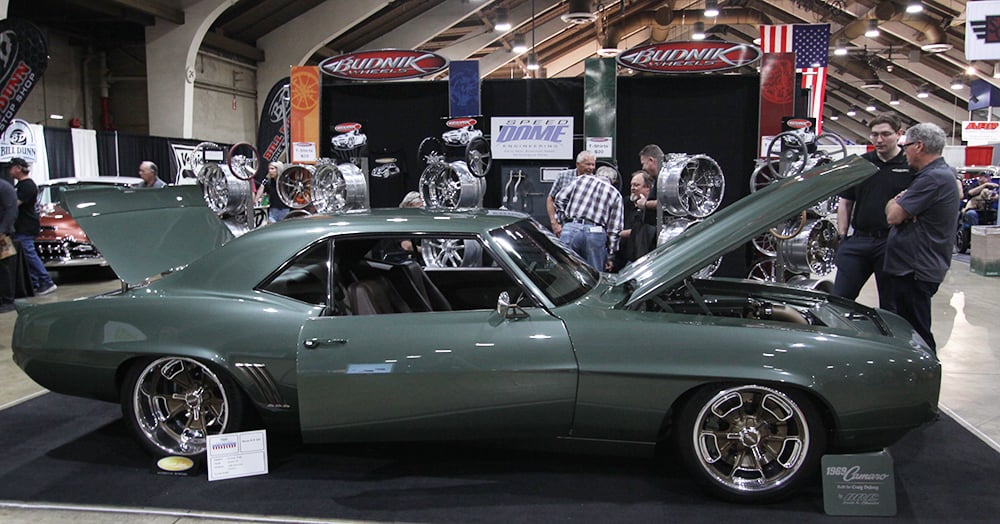
Above: 1969 Camaro pro touring photographed at the 2026 Grand National Roadster Show (courtesy of the humble scribe)
Many of you know that Classic Industries was first named Classic Camaro over 40 years ago. If you're renewing, restoring, maintaining, and/or restomodding your Chevrolet Camaro, Classic Industries is an awesome source for Camaro components and accessories. You can shop online and augment your GM pony car parts search with a printed Camaro Parts & Accessories Catalog. Simply click the button below, fill out the form, and we'll mail you a Camaro catalog. You can also obtain a free digital Camaro catalog, so you can always have instant access to Classic Industries' awesome Camaro collection of parts and accessories. Have fun in your garage, on the open road, and at the show 'n shines of your choosing!