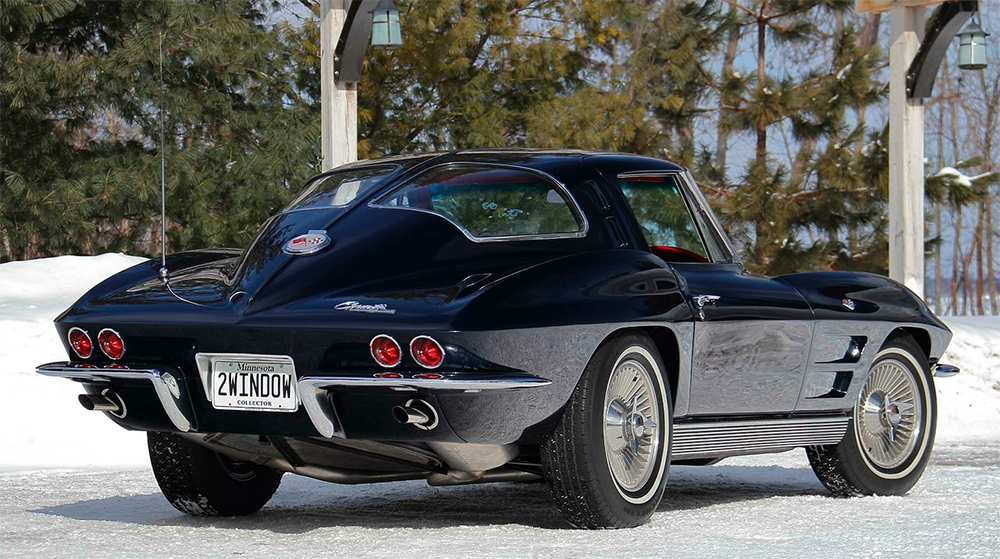


Few cars invite closer inspection than a 1963-1967 Chevrolet Corvette. At any show, auction, or cars-and-coffee, someone will eventually lean over the passenger-side fender looking for numbers. There's a good reason: the difference between an ordinary small-block Sting Ray and a documented, original-drivetrain big-block car can be six figures or more.
This guide shows you how to read those numbers, what each one can prove, and where each one stops.
Who This Guide Is Good For
- Buyers checking a C2 before they bid or make an offer
- Owners and restorers confirming what their car left St. Louis with
- Sellers who want to document a car's story accurately
- Enthusiasts who just want to understand what makes one Mid-Year worth more than another
Decode Your C2 in Six Steps
- Confirm the model year from the VIN. The format changed in 1965, so start with the year. (See: 1963-1964 VIN Decoder, 1965-1967: The C2 VIN Changes)
- Read the trim tag under the glovebox for body build date, body style, paint, and interior. (See: C2 Trim Tag Decoder)
- Find the engine assembly stamp on the passenger-side front engine pad. Decode the plant letter, date, and two-letter suffix for that specific model year. (See: Engine Codes by Year)
- Compare the partial VIN on the engine pad with the car's VIN sequence. This is what "matching numbers" really means. (See: "Numbers Matching" Means More Than Finding the Right Suffix)
- Check that the dates line up: block casting date, then engine assembly date, then body build date. Carry the same logic through the heads, intake, transmission, and rear axle. (See: The Casting Date Has to Make Sense)
- Back it all up with paperwork: tank sticker, window sticker, Protect-O-Plate, dealer invoice, shipping data, and ownership history. (See: Paperwork Can Be Worth Its Weight in Fiberglass)
What each number can and can't prove
|
Evidence |
What it proves |
What it can't prove |
|
VIN |
Model year, body style, assembly plant, production sequence |
Engine, transmission, or options |
|
Trim tag |
Body build date, body style, paint, interior trim |
Engine, drivetrain, or option list |
|
Engine suffix |
What application the engine was built for |
That it was installed in this car |
|
Partial VIN |
That the engine was assigned to this car |
That the stamping hasn't been altered |
|
Casting and assembly dates |
Whether the timeline is plausible |
Originality on its own |
|
Documentation |
Factory options and original configuration |
Condition or later changes |
The short version: the VIN tells you what Corvette you have, the engine stamp tells you what engine you're looking at, and the partial VIN tells you whether the two belong together. No single number tells the whole story.
Lead C2 '67 Sting Ray Convertible

Above and below: VIN Serial Number: 194677S104512 - The lead photo, the engine shot just above, the highlights, and the photos below are of a Marina Blue 1967 Corvette convertible that has the following alluring attributes in words and photos. The Marina Blue Sting Ray sold for $302,500 at the Kissimmee, Florida Mecum Auctions' January 2026 event.
- NCRS Top Flight winner
- Frame-off restoration to like original specifications
- Documented with the tank sticker, car shipper and invoice, all three documents contained together in frame and validated by NCRS
- L71 427/435 HP V-8 engine
- Al Grenning CCAS engine pad certification
- M21 close ratio 4-speed manual transmission
- 1 of only 267 Corvettes produced with J56 heavy-duty power brakes in 1967
- F41 special suspension
- 4.11 Positraction rear end
- Side exhaust (originally equipped with N11 off road service exhaust)
- Headrest seats
- AM/FM radio
- Tinted glass
- Color-matched hardtop and Black soft top
- Rally wheels
- Bias-ply Whitewall tires

The second-generation Corvette, better known as the C2 or Mid-Year Corvette, packed an extraordinary amount of change into just five model years. Chevrolet introduced the Sting Ray coupe in 1963, four-wheel disc brakes and the first big-block Corvette in 1965, the 427 in 1966, and the legendary L88 in 1967. During those five years, Chevrolet produced 117,964 C2 Corvettes: 45,546 coupes and 72,418 convertibles.

Today, the difference between an ordinary small-block Sting Ray and a documented, original-drivetrain big-block car can be enormous. That's why learning to read a C2's numbers isn't merely an exercise for Corvette historians. It's an essential skill for anyone buying, selling, restoring, or authenticating one.


All New 1963 Corvette Split-Window Coupe!
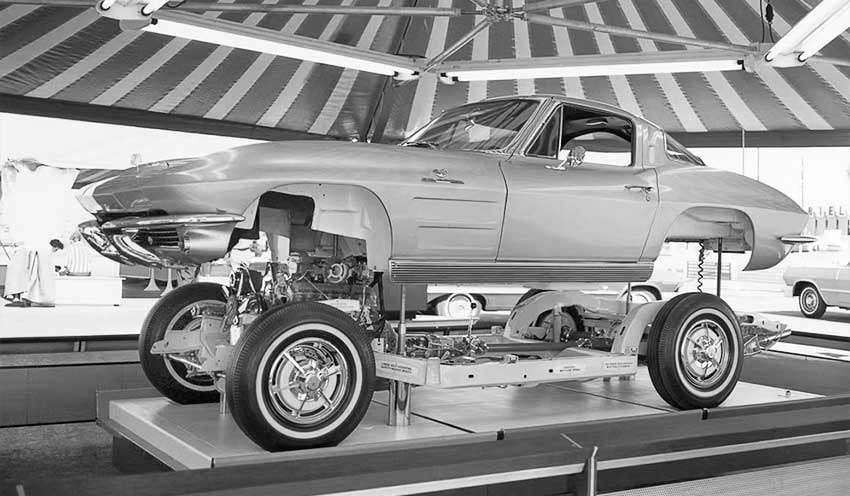
Above: The all-new 1963 Corvette's chassis had a shorter wheelbase, with improved weight distribution (photo courtesy of GM Media Archives). Zora Arkus-Duntov's team of engineers moved the engine back in the chassis and added 80 pounds to the rear suspension, which made for a better front to rear weight balance - practically 50/50 weight distribution. With the incorporation of a single transverse leaf spring and shock absorbers for the rear, the chassis also had four-wheel independent suspension for the first time ever. In addition, the two passengers actually now sat inside the frame rails, which lowered the center of gravity for the Corvette Sting Ray. A brilliant and bewitching form followed a seriously enhanced and innovative function, which transformed the C2 Corvette into a world class sports car! (DBS note: I love this GM Media Archives photo of the '63 Corvette split-window Sting Ray, so I pretty much publish this image for every C2 article that I write, like this one: 1963-67 C2 Corvette: History, Prices, Engine Options, & Production Numbers).
1963-1964 Corvette VIN Decoder

Above and below: Serial number: 30837S103415 - A top of the line 1963 split-window Corvette is powered by the Rochester mechanical fuel injection system atop its matching numbers 327 small-block V8 that sports 360 horsepower and is backed by a Muncie four-speed manual transmission (sold at Mecum Auctions Indy 2024 for $302,500). The specific highlights are below as are more photos.
- No expense-spared frame-off restoration completed in November 2023
- Riverside Red with Red interior
- Matching numbers fuel-injected 327/360 HP V-8 engine
- 4-speed manual transmission
- Knock-off wheels with ultra rare two-bar spinners
- Radio delete
- Heater delete
- Restoration photo album
- NCRS shipping data report
- Sold new at Martz Chevrolet in Menominee Falls, Wisconsin
- 1963 was the first year for the second generation Corvette and the only year for the Split Window Coupe

Chevrolet used essentially the same VIN format for the first two years of C2 production.
Consider this hypothetical 1963 Corvette:
30837S100001
|
VIN Position |
Code |
Meaning |
|
1 |
3 |
1963 model year |
|
2-3 |
08 |
Corvette series |
|
4-5 |
37 |
2-door coupe |
|
6 |
S |
St. Louis assembly plant |
|
7-12 |
100001 |
Production sequence |
For a convertible, the body-style characters change from 37 to 67.

Consequently:
30837S100001 = 1963 Corvette coupe
30867S100001 = 1963 Corvette convertible
The 1963 production sequence ran through 121513, corresponding to total production of 21,513 Corvettes.


The formula continued for 1964. A VIN such as:
40867S100001
decodes as a 1964 Corvette convertible assembled in St. Louis, with the final six digits providing its production sequence. Chevrolet built 22,229 Corvettes for 1964.
Notice what's missing from these VINs: the engine option.

You cannot look at a 1963 or 1964 Corvette VIN and determine whether the car left St. Louis with the base engine or the hottest fuel-injected small-block. That's where the engine-pad stamping enters the picture.
Video: C2 Corvette Grand Sport: The Ultimate 1963 Corvette!
Chevrolet built just five original C2 Corvette Grand Sport race cars, and all five were built as 1963 models. Chevrolet itself confirms that the C2 Grand Sport program began in 1963 as a purpose-built lightweight race car developed under Corvette chief engineer Zora Arkus-Duntov.

Above: Serial number: 30837X100003 - 1963 Corvette Grand Sport race car #003 - Sold at RM Sotheby's Auction during Monterey Car Week 2026 for $18,705,000 USD - Chassis #003 has an X in the sixth position, where every regular-production 1963 car has S for St. Louis. That's your first clue that this is not a production Sting Ray. Chevrolet built only five Grand Sports under Zora Arkus-Duntov before GM's ban on factory racing ended the program. (Photos of chassis #003 and others of #003 courtesy of Genau AutoWerks Ingo Schmoldt 2026 courtesy of RM Sotheby's).

Above: Race #2 at the 1964 Sebring 12 Hours, the Chassis #003 1963 Corvette Grand Sport leads Shelby American's Shelby Cobra #1, driven by Ken Miles and John Morton, and Ecurie Ford France's Shelby Cobra #14, driven by Jo Schlesser and Phil Hill (photo courtesy of the owner). Should you consider yourself to be a hotshoe and huge 1963 Corvette Grand Sport enthusiast, you'll want to check out this definitive history of the five Grand Sport Sting Ray purpose built race cars: Videos: The Legendary Tale of the Five 1963 Corvette Grand Sports Racers.
1964 Corvette VIN Decoder

Above and below: Serial number: 40867S103440 - Here's an Ermine white with red interior 1964 Corvette convertible that has its matching number 375 horsepower 327 cubic inch V8, thanks to the Rochester mechanical fuel injection, that is backed by a Muncie four-speed manual transmission. This white over red ragtop sold at Mecum Auctions Indy 2023 sale for $81,400. The first three Corvettes in this article are Marina Blue, Riverside Red, and Ermine White = Red, White, and Blue = America's Sports Car.
- Matching numbers drivetrain
- L84 fuel-injected 327/375 HP V-8 engine 4103440/FI01RF
- 4-speed manual transmission
- Correct code 936AA Ermine White exterior
- White convertible soft top
- Trim code 490 AB Red vinyl interior
- Power windows
- AM/FM radio
- 3.70 Positraction rear end code CO 10, 3, 63
- Power brakes
- Knock-off aluminum wheels
- Redline Radial tires


1965-1967: The C2 VIN Changes

Above and below: Serial number: 194375S122913 - Unrestored and Meticulously Preserved, 1 of Only 749 1965 396/425 HP Corvette Coupes Produced. You're looking at a veritable time capsule car in Silver Pearl over black. Feast your eyes on the several photos below and the delicious details of this Corvette survivor coupe. The big-block hood was used on the '65 and '66 Sting Rays. Believed to be the last 1965 Sting Ray equipped with a 396 cubic inch big block V8, the coupe sold for $209,000 at the Mecum Auctions' Indy 2026 event this past May.

- Unrestored, highly documented and meticulously preserved reference example representing the final evolution of the first-year big block Corvette
- Among the most factory-original, unrestored 1965 396/425 HP Corvettes known to exist
- A definitive late-production example of the first-year big block Corvette
- 1 of 749 1965 396/425 HP Corvette coupes produced
- Late-production example built on July 23, 1965, and delivered new through Davies Chevrolet in Glendora, California, on October 7, 1965, representing the final evolution of first-year big block Corvette production
- Believed to be among the final first-year 396/425 HP V-8-equipped Corvettes produced in 1965
- Known as "The Stud"
- Retained within single-family ownership for more than 52 years, including over 40 years of continuous ownership by its original caretaker
- Original, factory-applied Silver Pearl paint over the original fiberglass body
- Original, unrestored L78 396/425 HP V-8 engine, M20 wide-ratio 4-speed manual transmission and 4.11:1 Positraction rear axle
- Retains its original, factory-assembled drivetrain and major components
- Retains its original trim and VIN tags
- Factory equipped with 11 options, including F40 heavy-duty suspension, a Teakwood steering wheel and an AM/FM radio with power antenna
- Retains remarkably well-preserved factory-original chassis finishes and suspension components, including factory-applied chassis Black, inspection markings, original body mounts with factory assembly tape, front and rear springs with tags and factory-installed Delco shocks
- Used as an authoritative factory reference example in the development and documentation of the NCRS 1965 Corvette Technical Information Manual and Judging Guide, establishing the definitive benchmark for late-production 396/425 HP Corvette authenticity, restoration and refinement
- Has never been submitted for NCRS or Bloomington Gold judging and has remained largely unseen for nearly six decades
- Has never been publicly displayed prior to its invitation-only appearance as part of the 396 Trio Invitational Display at the 2025 Muscle Car and Corvette Nationals
- Awarded the inaugural John Kraman Award recognizing preservation and authenticity at the 2025 Muscle Car and Corvette Nationals
- Two full-size binders documenting ownership, provenance and 55,913 miles, including period and recent purchase documentation, dated titles, registrations, insurance records, original keys and an extensive photographic archive supporting its preservation and reference-level authenticity
- Engine pad, VIN and trim tag affirmations by CCAS
- NCRS Shipping Data Report
- Exceptionally original, highly preserved late-production 396/425 Corvette retaining rare one-year-only components and fully developed production characteristics
- Late-production example reflecting the fully established and refined configuration of the 396/425 Corvette, incorporating standardized production features
- Factory-original 962 engine block, correct dated cylinder heads, 963 aluminum intake manifold, 301 and 302 exhaust manifolds, and rare one-year-only 3124 Holley carburetor
- Very rare original components include the complete one-year-only air cleaner assembly with air lid, original air filter element, base and wingnut; correct GF 416 fuel filter; original fuel lines; original radiator hoses; embossed dipstick and oil cap; and the ultra-rare, original 352 starter and brace
- Original K66 transistor ignition system, including amplifier, one-year-only 210 coil and original factory wiring harnesses
- Retains original factory details that remain visible and intact, including engine-bay Blackout, production line drips, hood surround with factory dimple, factory sealants and original assembly procedures
- Retains original riveted ball joints, GM tie rods, big-block sway bars and half shafts, preserving factory assembly characteristics
- Original steering, suspension and braking components, including first-year 4-wheel disc brakes, retaining original hoses, fittings and assembly characteristics
- Original, unrestored interior components, including dash pads, door panels, headliner, vinyl seats and backs, carpet, console, shifter, gauges and floor mats
- Original, factory-optioned welded off-road exhaust system
- Kelsey-Hayes steel wheels and factory wheel covers
- Original, rare, factory-optional, non-DOT Firestone Deluxe Champion Whitewall tires, including matching spare

Chevrolet revised the Corvette VIN format for 1965.
Consider:
194675S100001
It breaks down this way:
|
VIN Position |
Code |
Meaning |
|
1 |
1 |
Chevrolet division |
|
2-3 |
94 |
Corvette series |
|
4-5 |
67 |
Convertible |
|
6 |
5 |
1965 model year |
|
7 |
S |
St. Louis assembly plant |
|
8-13 |
100001 |
Production sequence |
A coupe substitutes 37 for 67.
The same basic format continued through the end of C2 production. Therefore:
194376Sxxxxxx = 1966 Corvette coupe
194676Sxxxxxx = 1966 Corvette convertible
194377Sxxxxxx = 1967 Corvette coupe
194677Sxxxxxx = 1967 Corvette convertible.

There's an important lesson here for anyone shopping for a big-block Corvette: the VIN still doesn't tell you whether the car originally had a 327, 396, or 427.
A VIN beginning 194677S proves you're looking at a 1967 Corvette convertible. It does not prove that it's a factory 427/435-horsepower car.
For that, we'll need more evidence.

The C2 Corvette Engine Pad: Where Things Get Interesting
Look at the machined pad at the front of the engine block on the passenger side, immediately ahead of the cylinder head.
On an original C2 engine, this area contains some of the most important characters on the entire automobile.
Generally, you're looking for two pieces of information:
Engine assembly code
VIN derivative, or partial VIN
An engine assembly stamping might look something like:
F0118RC
That translates to:
F = Flint engine assembly plant
01 = January
18 = 18th day of the month
RC = engine application suffix
In this example, RC identifies a 327/250-horsepower engine for a 1964 Corvette with manual transmission.
That two-letter suffix can reveal considerably more about a C2's original engine configuration than the vehicle VIN.
1963-1967 C2 Corvette Trim Tag Decoder
Beginning with the 1963 Sting Ray, Chevrolet added a body paint-and-trim identification plate to the Corvette. On 1963-1967 C2s, the trim tag is found beneath the glovebox on the right-side metal hinge-pillar/cross brace structure under the instrument panel. The VIN plate is located in the same general area, but the two plates serve very different purposes. NCRS documentation describes the trim tag as being pop-riveted to the right side of the hinge-pillar brace below the glove compartment.
A C2 trim tag can identify:
Body build date • Model year • Body style • Body source/sequence number • Interior trim • Exterior paint
It does not normally identify the engine, transmission, rear-axle ratio, or complete factory option list. Consequently, a 1967 trim tag cannot by itself prove that a Corvette was born with a 427/435, just as a 1965 tag cannot establish that the car originally carried the L78 396.
Reading the C2 Trim Tag
A typical tag contains information arranged something like this:
G11
STYLE 64 867 — BODY S7403
TRIM 898FA — PAINT 940AA
In this documented 1964 example, G11 is the body-build date; 64 identifies the 1964 model year; 867 identifies a convertible body; S7403 is the body-source/sequence information; 898FA identifies red leather upholstery; and 940AA identifies Satin Silver exterior paint.
Body Style Codes
For 1963-1964, the trim-tag body-style codes are:
|
Code |
Body |
|
837 |
Coupe |
|
867 |
Convertible |
For 1965-1967, Chevrolet's tag format uses:
|
Code |
Body |
|
437 |
Coupe |
|
467 |
Convertible |
A documented 1966 tag, for example, reads STYLE 66 467 for a 1966 convertible.
Body Build-Date Codes
The 1963 Corvette is different from the remaining C2 years. Its tag uses a letter for the month followed by a number indicating the week. Thus, H2 signifies the second week of April. The month sequence began with A = September 1962, followed by B = October, C = November, D = December, E = January 1963, F = February, G = March, H = April, I = May, J = June, K = July, and L = August.
For 1964-1967, the number following the month letter represents the day of the month, rather than the week. A code such as G11 therefore identifies March 11.
One authentication nuance is important: NCRS notes that the trim-tag date represents when the body passed the trim-tag station; it should not automatically be interpreted as the Corvette's exact final-assembly date.
St. Louis Versus A.O. Smith Bodies
Another fascinating C2 detail appeared during 1964 production. Chevrolet began obtaining Corvette bodies from A.O. Smith in addition to bodies produced at St. Louis.
From mid-1964 through 1967, the letter preceding the body number identifies the source:
A = A.O. Smith body
S = St. Louis body
A.O. Smith bodies entered production during the 1964 model year; Chevrolet documentation associates the identification change with cars beginning around VIN 109678. Before this change, early 1964 body numbers did not carry the A/S source prefix.
Don't confuse the body number with the Corvette's VIN sequence. They are separate numbering systems.
1963-1967 Corvette Exterior Paint Codes
|
Year |
Code |
Factory Exterior Color |
|
1963 |
900 |
Tuxedo Black |
|
912 |
Silver Blue |
|
|
916 |
Daytona Blue |
|
|
923 |
Riverside Red |
|
|
932 |
Saddle Tan |
|
|
936 |
Ermine White |
|
|
941 |
Sebring Silver |
|
|
1964 |
900 |
Tuxedo Black |
|
912 |
Silver Blue |
|
|
916 |
Daytona Blue |
|
|
923 |
Riverside Red |
|
|
932 |
Saddle Tan |
|
|
936 |
Ermine White |
|
|
940 |
Satin Silver |
|
|
941 |
Special Silver Combination |
|
|
1965 |
AA |
Tuxedo Black |
|
CC |
Ermine White |
|
|
FF |
Nassau Blue |
|
|
GG |
Glen Green |
|
|
MM |
Milano Maroon |
|
|
|
Silver Pearl |
|
|
UU |
Rally Red |
|
|
XX |
Goldwood Yellow |
|
|
Y |
Crocus Yellow* |
|
|
1966 |
900 |
Tuxedo Black |
|
972 |
Ermine White |
|
|
974 |
Rally Red |
|
|
976 |
Nassau Blue |
|
|
978 |
Laguna Blue |
|
|
980 |
Trophy Blue |
|
|
982 |
Mosport Green |
|
|
984 |
Sunfire Yellow |
|
|
986 |
Silver Pearl |
|
|
988 |
Milano Maroon |
|
|
1967 |
900 |
Tuxedo Black |
|
972 |
Ermine White |
|
|
974 |
Rally Red |
|
|
976 |
Marina Blue |
|
|
977 |
Lynndale Blue |
|
|
980 |
Elkhart Blue |
|
|
982 |
Goodwood Green |
|
|
984 |
Sunfire Yellow |
|
|
986 |
Silver Pearl |
|
|
988 |
Marlboro Maroon |
The 1963-64, 1965, 1966 and 1967 factory-color listings are documented in Corvette production records.
*Crocus Yellow appears in 1965 records as an unusual/special-use listing rather than one of the normal high-volume production colors, so it should be treated separately from the standard palette.
There's another wonderful Corvette footnote in 1967: at least one documented COPO Bright Blue Corvette exists, identified in Corvette Action Center's production information as RPO 001 Bright Blue. It should not be confused with the regular-production Marina, Lynndale, or Elkhart Blue colors.
C2 Corvette Interior Trim Codes
The interior coding is where a year-by-year decoder becomes particularly useful because Chevrolet changed the system substantially during C2 production.
1963
The inaugural Sting Ray used a more complicated trim-code system than the later C2s. STD or BLK identifies Black vinyl. Other vinyl interiors generally begin with 490, while leather applications use 898, followed by suffix letters that can further identify color, body style and equipment/application differences.
The principal 1963 interior colors were Black, Dark Blue, Red, and Saddle, with vinyl and leather applications depending upon color and configuration. For example, surviving documentation confirms 490-series codes for Dark Blue, Red and Saddle vinyl, while 898-series codes were used for leather. Because the suffix letters can also reflect body/equipment differences—particularly air conditioning—1963 trim codes should be decoded using the complete code rather than merely the first three digits.
1964
The 1964 system remained comparatively elaborate:
|
Base Code |
Interior |
|
STD |
Black vinyl |
|
490 series |
Red, Blue or Saddle vinyl |
|
491 series |
Two-tone vinyl combinations |
|
898 series |
Leather |
The 491-series combinations included Silver/Gray, Silver/Blue, White/Black, White/Red, White/Blue, and White/Saddle. Leather was offered in Black, Saddle, Red, and Blue, with suffix letters identifying the precise application.
This is why a complete code such as 898FA matters more than simply saying “898 means leather.”
1965
By 1965, Chevrolet's system becomes much easier to read:
|
Code |
Interior |
|
STD |
Black vinyl |
|
402 |
Black leather |
|
407 |
Red vinyl |
|
408 |
Red leather |
|
414 |
Blue vinyl |
|
415 |
Blue leather |
|
420 |
Saddle vinyl |
|
421 |
Saddle leather |
|
426 |
Silver vinyl |
|
427 |
Silver leather |
|
430 |
Green vinyl |
|
431 |
Green leather |
|
435 |
Maroon vinyl |
|
436 |
Maroon leather |
|
437 |
White/Black vinyl |
|
438 |
White/Black leather |
|
443 |
White/Red vinyl |
|
444 |
White/Red leather |
These codes provide an excellent cross-check against the exterior color because Chevrolet offered specific recommended/available exterior-interior combinations.
1966
The 1966 interior codes were:
|
Code |
Interior |
|
STD |
Black vinyl |
|
402 |
Black leather |
|
407 |
Red vinyl |
|
408 |
Red leather |
|
414 |
Bright Blue vinyl |
|
415 |
Bright Blue leather |
|
418 |
Blue vinyl |
|
419 |
Blue leather |
|
420 |
Saddle vinyl |
|
421 |
Saddle leather |
|
426 |
Silver vinyl |
|
427 |
Silver leather |
|
430 |
Green vinyl |
|
450 |
White/Blue vinyl |
Chevrolet's 1966 records also identify the convertible-top colors as Beige, Black, and White.
1967
For the final C2 year:
|
Code |
Interior |
|
STD |
Black vinyl |
|
402 |
Black leather |
|
407 |
Red vinyl |
|
408 |
Red leather |
|
414 |
Bright Blue vinyl |
|
415 |
Bright Blue leather |
|
418 |
Teal Blue vinyl |
|
419 |
Teal Blue leather |
|
420 |
Saddle vinyl |
|
421 |
Saddle leather |
|
430 |
Green vinyl |
|
450 |
White/Blue vinyl |
|
455 |
White/Black vinyl |
Convertible tops were available in Black, Teal Blue, and White for 1967. Chevrolet production records list 7,030 Black, 611 Teal Blue, and 5,900 White soft tops.
What the C2 Trim Tag Can—and Cannot—Prove
For restorers, the trim tag is tremendously useful because it provides another independent checkpoint against the car's claimed history. A tag indicating 984 paint and STD trim on a 1966 Corvette, for example, identifies a Sunfire Yellow car with Black vinyl upholstery. A 1964 tag reading 940AA and 898FA identifies Satin Silver paint and red leather upholstery.
But the trim tag should never be treated as a C2 Corvette build sheet.
It does not normally tell you whether the car left St. Louis with a 327, 396 or 427; whether it had Rochester fuel injection; which four-speed was installed; its rear-axle ratio; or whether a big-block Corvette was an L36, L68, L71, L88 or L89.
Those questions require the next layers of evidence:
VIN → Trim tag → Engine assembly stamp → Partial VIN → Block casting/date → Heads and induction → Transmission → Rear axle → Protect-O-Plate → Dealer/factory documentation → Ownership history
That's the beauty of decoding a Mid-Year Corvette. No single number tells the entire story. The fun—and the authentication—comes from getting all the numbers to tell the same story.
1963 Corvette Engine Codes

Above and below: Serial number: 30837S115157 — This 1963 Corvette Sting Ray coupe was the 15,157th Corvette in the 1963 production sequence and was assembled at St. Louis during May 1963. Its engine pad carries assembly code F0429RF, identifying a Flint-built 327/360-horsepower L84 Rochester fuel-injected V8 assembled April 29, 1963 for manual-transmission use. More importantly, the accompanying engine VIN derivative, 3115157, corresponds exactly with the car's VIN production sequence of 115157. The dates and identification numbers therefore provide strong evidence that the block was assigned to this particular Corvette when new. You gotta love that exterior Daytona Blue hue! Apparently, she was well loved at the January 2026 Mecum Auctions Kissimmee, Florida event, selling for a considerable $709,500.


Every 1963 Corvette used a 327-cubic-inch small-block, but Chevrolet offered four horsepower levels.
|
Suffix |
Engine |
Induction |
Transmission |
|
RC |
327/250 hp |
4-barrel |
Manual |
|
RD |
327/300 hp |
4-barrel |
Manual |
|
RE |
327/340 hp |
4-barrel |
Manual |
|
RF |
327/360 hp |
Rochester fuel injection |
Manual |
|
SC |
327/250 hp |
4-barrel |
Powerglide |
|
SD |
327/300 hp |
4-barrel |
Powerglide |
The RF suffix is the attention-getter. It identifies the 360-horsepower Rochester fuel-injected 327, the hottest production engine available in the inaugural Sting Ray. Chevrolet lists Rochester fuel-injection unit 7017375 for the application.

Interestingly, all 1963 and 1964 Corvette engines used block casting 3782870, meaning the block casting number alone cannot distinguish a 250-horse cruiser from a 360-horse fuelie. Cylinder-head, induction-system, distributor, date-code, engine-pad, and documentation evidence therefore become crucial.


1964 Corvette Engine Codes
The Corvette's 327 became hotter for 1964. The previous 340- and 360-horsepower versions gave way to 365- and 375-horsepower combinations.
The principal suffix codes included:
|
Suffix |
Engine |
Basic Configuration |
|
RC |
327/250 hp |
Manual |
|
RD |
327/300 hp |
Manual |
|
RE |
327/365 hp |
Manual |
|
RF |
327/375 hp |
Fuel injection/manual |
|
RP |
327/250 hp |
MT, A/C |
|
RQ |
327/300 hp |
MT, A/C |
|
RR |
327/365 hp |
MT, A/C |
|
RT |
327/365 hp |
MT, transistor ignition |
|
RU |
327/365 hp |
MT, A/C, transistor ignition |
|
RX |
327/375 hp |
Fuel injection/MT/transistor ignition |
|
SC |
327/250 hp |
AT |
|
SD |
327/300 hp |
AT |
|
SK |
327/250 hp |
AT, A/C |
|
SL |
327/300 hp |
AT, A/C |
*Engine codes confirmed with Corvette Black Book 1953-2013 - Mike Antonick, author
Additional codes were used for specific combinations, so a restorer should always decode the suffix against the correct model year rather than assuming a particular two-letter code meant the same thing throughout C2 production.
That last point is worth emphasizing: never decode a Corvette engine suffix without knowing the model year. Remember: 1964 Corvette engines used block casting 3782870, as did 1963 Corvette engines.
1965: Fuel Injection Meets the Big Block

Above and below: Serial number: 194375S111648 - 1965 Corvette coupe 1 of 41 Produced, L79 327/350 HP V-8, Bloomington Gold Certified, NCRS Duntov Mark of Excellence - Sold for $357,500 at the Mecum Auctions' 2026 Kissimmee, Florida event in January, Attributes:
- 1 of only 41 Corvette Coupes produced in 1965 with RPO N03 36-gallon fuel tank
- Bloomington Gold Certified
- NCRS Top Flight wins at the Chapter, Regional and National levels
- NCRS Performance Verification
- NCRS Duntov Mark of Excellence
- Please note that the physical awards will not be included
- Meticulous frame-off restoration
- L79 327/350 HP V-8 engine
- M20 4-speed manual transmission
- Factory air conditioning
- Positraction rear end
- 4-wheel power disc brakes
- Power steering
- Power windows
- Original dealer order form
- Dealer invoice
- NCRS Shipping Data Report
- Delivered new to Roger Dean Chevrolet in Huntington, West Virginia
- Soft Ray tinted glass
- Telescopic steering column
- Radio delete
- Teakwood steering wheel
- Kelsey Hayes knock-off wheels
- Goldwall bias ply tires

The 1965 Corvette represents one of the great mechanical crossroads in Corvette history.
At one end of the spectrum was the Rochester fuel-injected 327/375-horsepower L84. At the other was Chevrolet's new 396/425-horsepower L78 big-block.

Above and below: RPO N03 36-gallon fuel tank - Notice this Sting Ray coupe also sports Frigidaire air conditioning. Back in the day, J. Evan Sadler, Jr., traded in his 1963 Corvette split-window coupe for this fully loaded Ermine White over white and black 1965 Sting Ray coupe.

And in between sat the excellent 327/350-horsepower L79.
The major engine choices included the base 327/250, L75 327/300, L79 327/350, L76 327/365, L84 fuel-injected 327/375, and L78 396/425. Chevrolet produced only 771 L84 fuel-injected Corvettes, while 2,157 received the 396/425.

Among the important 1965 engine suffixes are:
|
Suffix |
Engine/Application |
|
HE |
327/250 hp, manual |
|
HF |
327/300 hp, manual |
|
HG |
327/375 hp, fuel injection/manual |
|
HH |
327/365 hp, manual |
|
HT |
327/350 hp, manual |
|
IF |
396/425 hp, manual |
There are additional suffixes covering automatic transmission, air conditioning, transistor ignition, and other combinations, so these should be viewed as the headline codes rather than an exhaustive 1965 list.

The 396 also gives us another decoder clue. C2 small blocks were assembled at Flint, while the 1965 396 was assembled at Tonawanda. Thus a 396-engine assembly stamping begins with T, rather than the Flint F prefix.
A stamping such as:
T0315IF
would therefore identify a Tonawanda-assembled engine, built March 15, with the IF 396/425 Corvette application suffix.
For a numbers-minded Corvette enthusiast, that's when decoding starts becoming addictive.
1966: Here Comes the 427

Above and below: Serial number: 194676S100959 - 1966 Corvette convertible with the 427/450 HP L72 V-8, 4-Speed - Sold at Mecum Auctions Kissimmee, Florida 2024 event for $110,000 - The delightful details on this Milano Maroon Metallic Sting Ray convertible are below, in photos and words:
- Bloomington Gold Certified
- Bloomington Gold Special Collection
- NCRS Top Flight, 98.2/100 points
- NCRS Duntov Mark of Excellence Award
- Chevy Vettefest Triple Crown
- Naber Brothers frame-off restoration of early production (fall 1965) 427 CI model
- 427/450 HP L72 V-8 engine* (most of the '66 model year rated at 425 HP by Chevrolet)
- Muncie M21 4-speed manual transmission
- Milano Maroon
- Black convertible soft top
- 3.70 geared Positraction rear end
- Transistor ignition
- Off-Road exhaust
- 5 original Kelsey Hayes aluminum knock-off wheels
- Goodyear Gold stripe tires
- Black interior
- Teakwood steering wheel
- AM/FM radio
- Tinted glass

For 1966, Chevrolet retired the Corvette's one-year 396 and bored the Mark IV big-block to the now-legendary 427 cubic inches.

The base 327 was rated at 300 horsepower, with the L79 327/350 available for buyers wanting small-block balance with substantially more punch.
Then there were the big blocks.
The L36 delivered 390 horsepower, while the top L72 427, was first advertised at 450 hp* and a bit later rated 425 hp for most of the model year by Chevrolet. Corvette Action Center notes that the claimed rating changed, rather than necessarily indicating a mechanical reduction in output.

Above: The engine pad reveals the 1966 Sting Ray convertible, regally wrought in Milano Maroon Metallic, is equipped with the IP engine, to whit, a 427/425 hp - early 450-hp rating - manual (for four-speed Muncie manual transmission)! Let's get right down into the specifics:
T0909IP decodes as:
- T = Tonawanda, New York engine assembly plant
- 09 = September
- 09 = 9th day of the month
- IP = 427-cubic-inch, 425-horsepower big-block for a manual-transmission Corvette
1966 Chevrolet Corvette Convertible — VIN 194676S100959, the 959th Corvette of the 1966 model-year production run. Its engine pad is stamped T0909IP, identifying a Tonawanda-built 427/425-horsepower L72 big-block assembled September 9, 1965 for manual-transmission use. The accompanying engine VIN derivative, 6100959, matches the Corvette's 100959 VIN production sequence exactly. If you purchased this beauty, you probably wouldn't want to restomod it!

Important 1966 suffixes include:
|
Suffix |
Engine/Application |
|
HE |
327/300 hp, manual |
|
HO |
327/300 hp, automatic |
|
HT |
327/350 hp, manual |
|
HP |
327/350 hp, manual/power steering |
|
HD |
327/350 hp, AIR/manual |
|
IK |
427/425 hp, manual |
|
IL |
427/390 hp, manual |
|
IM |
427/390 hp, AIR/manual |
|
IP |
427/425 hp — early 450-hp rating — manual |
|
IQ |
427/390 hp, automatic |
|
IR |
427/390 hp, AIR/automatic |
The AIR designation refers to Chevrolet's Air Injection Reactor emissions system.

Block casting numbers provide another piece of the puzzle. Corvette identification records list 3858174 for the 327 and 3869942 for the 427, along with additional early/late-production castings.
1967: The C2 Goes Out with a Bang

Above and below: Serial number: 194677S109097 - 1967 Sting Ray L88 convertible - The First Production 1967 Corvette L88, Campaigned by Tony DeLorenzo - The Tuxedo Black racing machine sold at Mecum Auctions' Monterey 2024 during Monterey Car Week in August for, wait for it, $2,352,000! All of the scintillating details, in words and photos, are below:
- The first production Corvette L88
- One of the most historically significant L88s in existence
- 1 of only 20 produced in 1967
- The only Tuxedo Black 1967 L88 Convertible built
- A-production race car campaigned by Tony DeLorenzo and Jerry Thompson in 1967
- B-production race car in 1968/1969
- Winner of the 1982 Canadian Western GT Championship
- Sponsored by Owens-Corning and Hanley Dawson Chevrolet
- Second Place at the 1967 Daytona Beach SCCA Runoffs
- Protect-O-Plate with Al Grenning/CCAS affirmation
- Original trim tag with Al Grenning/CCAS affirmation
- Original 1967 title
- Naber Brothers restoration
- Bloomington Gold certified in 1984
- Multiple Bloomington Gold Special Collection appearances in 1985, 1988, 1992 and 2020
- Multiple NCRS Top Flight awards
- The very first 1967 Corvette to win the Zora Arkus Duntov Mark of Excellence award in 1985
- MCACN Triple Diamond award in 2010
- NCRS American Heritage award in 2013
- Reunited with Tony DeLorenzo at the 2003 Monterey Historics
- Documented with a letter of Testimony from Tony DeLorenzo, ownership history (including Tony DeLorenzo, Jerry Thompson, Doug Hooper, Wayne Walker, Steve Hendrickson, Larry Bowman, Terry Michaelis and Chuck Ungurean to name a few), race grids and race results, Watkins Glen 500 August 1967 program, invitations to the “Special Collection”, Special Collection booklet scans, judging certificates from NCRS and Bloomington Gold, certificate of authenticity from the Franklin Mint and five three-ring binders
- This Tuxedo Black Convertible is certainly one of the most photographed L88 Corvettes and has been editorialized in an extraordinary amount of reputable publications and websites including (but not limited to) Corvette: A Piece of the Action, the GM publication Corvette News, Registry of Corvette Race Cars, Corvette Racing Legends, The Best of Corvette News, Corvette: An American Legend, Old Cars Weekly, Hemmings Muscle Machines, Corvette and Chevy Magazine, Corvette Fever Magazine, Automobile Quarterly’s Quatre Foil magazine, Zip Products 1985 catalog, Franklin Mint’s Precision Models and the August 1968 issue of Birmingham Eccentric
- 427/430 HP L88 V-8 engine with aluminum heads
- M22 heavy duty close ratio 4-speed manual transmission
- 3.70 Positraction rear end
- Factory side exhaust
- Auxiliary hardtop
- Power windows
- Transistor ignition
- J56 special heavy duty power brakes
- F41 special suspension
- Kelsey Hayes bolt-on wheels
- Vintage Goodyear Speedway Blue streak tires

If you're going to end a generation, this isn't a bad way to do it.
The final C2 Corvette could be ordered with everything from a 327/300-horsepower small-block to one of the most famous Chevrolet racing engines ever sold to the public.

Important 1967 suffix codes include:
|
Suffix |
Engine/Application |
|
HE |
327/300 hp, manual |
|
HO |
327/300 hp, automatic |
|
HT |
327/350 hp, manual |
|
HD |
327/350 hp, AIR/manual |
|
IL |
427/390 hp, manual |
|
IM |
427/390 hp, AIR/manual |
|
IQ |
427/390 hp, automatic |
|
IR |
427/390 hp, AIR/automatic |
|
JC |
427/400 hp, manual |
|
JD |
427/400 hp, automatic |
|
JF |
427/400 hp, AIR/manual |
|
JG |
427/400 hp, AIR/automatic |
|
JE |
427/435 hp, manual |
|
JA |
427/435 hp, AIR/manual |
|
IU |
427/435 hp, aluminum heads/manual |
|
JH |
427/435 hp, AIR/aluminum heads/manual |
|
IT |
427/430 hp L88, manual |

This is where decoding becomes particularly important. Chevrolet offered the L68 427/400, L71 427/435, L89 aluminum-head version of the L71, and the competition-oriented L88 427/430. Only 20 L88 Corvettes were produced for 1967, while just 16 L89 aluminum-head cars were built.
Those numbers explain why authenticating one involves considerably more than finding the right letters stamped into an engine pad.

Above: 1967 Corvette convertible L88 Tony Delorenzo A & B production race car sold at the Mecum Auctions 2024 Monterey Auction for $2,352,000 (majority of photos for this article are courtesy of Mecum Auctions)
“Numbers Matching” Means More Than Finding the Right Suffix
Here's where prospective buyers should slow down.
Suppose you've found a 1967 Corvette advertised as an original 427/435. You check the engine pad and discover the correct suffix.
Great.
But you're not finished.
A suffix tells you what application the engine was assembled for. By itself, it does not prove that the block was installed in this particular Corvette when the car was built.
That's why the partial VIN is so important.
C2 engines carry a VIN derivative on the engine pad. That derivative should correspond with the identifying portion of the vehicle's VIN. Corvette references describe the assembly code and VIN derivative as separate stampings on the passenger-side front engine pad.
Think of it this way:
Engine suffix = What was this engine built to be?
Partial VIN = Was this engine assigned to this Corvette?
That's a much more meaningful definition of “matching numbers.”
The Casting Date Has to Make Sense, Too
Casting numbers and dates add another layer of evidence.
An original engine block obviously had to exist before Chevrolet assembled the engine, and the completed engine had to exist before, or within a historically reasonable production relationship to the Corvette's final assembly.
That's why restorers compare:
Block casting date → Engine assembly date → Corvette body/final assembly date
If those dates move logically forward, that's encouraging.
If the supposedly original block was cast after the Corvette was completed, you've got a problem no amount of polishing will fix.
The same principle applies to cylinder heads, intake manifolds, and other date-coded components.
Heads, Intake, Carburetor and Fuel Injection
High-value C2 authentication can become an automotive version of detective work.
A correct block should be accompanied by the appropriate cylinder-head castings, intake manifold, carburetor or Rochester fuel-injection unit, and distributor.
Take the 1963 Corvette. Identification records list head casting 3795896 for the 250-horsepower engine and 3782461 for the 300-, 340-, and 360-horsepower engines. The fuel-injected 360-horsepower engine used Rochester FI unit 7017375.
Similarly, 1966 identification records list head casting 3872702 for the 427/390 and 3873858 for the high-horsepower 427.
One correct number is encouraging.
A complete collection of correct numbers, appropriate dates, untouched stampings and supporting paperwork is considerably more persuasive.
Don't Forget the Transmission and Rear Axle
The detective work continues underneath the car.
Transmission identification can help determine whether the gearbox is appropriate for the Corvette's engine and production date. The C2 era included Powerglide automatics and several manual-transmission configurations, with the Muncie four-speed becoming one of the signature pieces of the Mid-Year Corvette drivetrain.
By 1967, Chevrolet listed M20 wide-ratio, M21 close-ratio, and heavy-duty M22 four-speeds, in addition to the M35 Powerglide. Only 20 1967 Corvettes received the M22 - corresponding to the tiny L88 production run.
Rear-axle identification is equally useful. The axle code can establish the original ratio/application, while its assembly date provides another checkpoint against the Corvette's build chronology.
For an original-drivetrain car, you want the evidence to tell one coherent story.
The Trim Tag: Useful, but Don't Ask It to Do the VIN's Job
The C2 Corvette's trim tag provides another important group of clues.
Depending on model year and body supplier, it can provide information concerning the car's body build date, body number, trim, and original paint. A documented 1966 example, for instance, carries information identifying its build date, convertible body, black vinyl trim, St. Louis body number, and Sunfire Yellow paint.
But don't confuse the trim tag with a build sheet.
A C2 trim tag does not tell you that the car was born with a 427/435, side pipes, Positraction or a particular four-speed transmission.
In fact, a Corvette Action Center discussion of an original 1965 car makes this point explicitly: options cannot simply be determined from the VIN or trim tag.
That's why documentation becomes so valuable.
Paperwork Can Be Worth Its Weight in Fiberglass

Above and below: Serial number: 40837S112131 - 1964 Corvette coupe The "Jack Murray Tanker", 1 of 38 Produced, Bloomington Gold Hall of Fame Inductee - The Sting Ray Sold at Mecum Auctions Kissimmee, Florida 2026 event for $770,000! Glorious specifications in words and photos of this Tuxedo Black '64 Sting Ray coupe are below:
- Universally known as the "Jack Murray Tanker"
- 1 of only 38 Corvette Coupes produced with the N03 36-gallon fuel tank
- Regarded by many as the finest surviving 1964 Big Tank Fuelie in existence
- Ordered new by Ed Sullivan, a GM employee in the GM Marketing Department
- Specially commissioned through Luby Chevrolet in Denver, Colorado in December 1963
- At the time, Sullivan already owned a 1963 Z06-style competition Corvette and wanted its spiritual successor for 1964 but with the livery reversed to Tuxedo Black with a Silver interior
- Due to the specialized competition equipment specified, production stretched to nearly seven months, prompting Sullivan to receive a formal apology letter from the St. Louis assembly plant
- The car was completed on February 27, 1964 and delivered on March 6, 1964
- The car disappeared from view after September 1964, resurfacing in 1975 when it was discovered by racer and Corvette Authority Jack Murray with 12,657 miles on the odometer
- Displayed by Murray at Bloomington Gold events from 1987-1995
- Inducted into the Bloomington Gold Hall of Fame in 1999
- Invited for public exhibition in 2000 at the National Corvette Museum as part of their Concours d'Performance exhibit
- Body-off-frame restoration performed in 2002 under the guidance of Gary Naber in Houston, Texas
- Original components were restored wherever possible
- Interior was preserved and left unrestored
- Letter from GM dated January 11, 1976 stating that this Corvette was ordered and specially-built and is believed to be the last and only full competition model built
- Never raced
- Window sticker
- Owner's manual
- Warranty booklet
- Two-time NCRS Top Flight winner
- Fuel-injected 327/375 HP V-8 engine
- Close ratio 4-speed manual transmission
- 36-gallon "Big Tank" fuel system
- Knock-off aluminum wheels
- Firestone Super Sport competition tires
- Heavy-duty competition suspension and steering
- Stabilizer bars and shocks
- 3.55 Positraction rear axle
- Original AM/FM radio


A well-documented C2 Corvette may retain some combination of:
Protect-O-Plate, original dealer invoice, sales contract, warranty paperwork, service records, registration documents, old titles, finance paperwork, owner correspondence and a documented chain of ownership.

Above: Here's the advertisement for the 1964 Corvette coupe, The "Jack Murray Tanker" (upper right hand corner - bracketed with blue ink), in the September 1964 Marketplace classified ads section of 'Road & Track' magazine (DBS note - That vintage German sports car in the lower left corner of the page looks familiar - what a great looking car).
These records can sometimes answer questions the VIN and trim tag cannot.

A Protect-O-Plate can be particularly valuable because it may preserve drivetrain and original-owner information that helps connect the physical numbers on the car with its history.
Original dealer paperwork can be better still, especially when it identifies factory equipment.
And ownership history gives the Corvette something no casting number ever can: provenance.

A 427 Corvette accompanied by decades of photographs, registrations, service receipts and correspondence is telling you its life story rather than merely presenting a collection of numbers.
C2 Corvette Production at a Glance
|
Year |
Coupe |
Convertible |
Total |
|
1963 |
10,594 |
10,919 |
21,513 |
|
1964 |
8,304 |
13,925 |
22,229 |
|
1965 |
8,186 |
15,376 |
23,562 |
|
1966 |
9,958 |
17,762 |
27,720 |
|
1967 |
8,504 |
14,436 |
22,940 |
|
Total |
45,546 |
72,418 |
117,964 |
*1963 Was the only year for the split-window Sting Ray coupe.
The C2 Corvette Authentication Chain
When evaluating a potentially original C2, don't become mesmerized by one promising stamping. Follow the entire chain:
VIN → Engine assembly stamp → Engine suffix → Partial VIN → Block casting number → Block casting date → Cylinder heads → Intake → Carburetor/fuel injection → Distributor → Transmission → Rear axle → Trim tag → Factory/dealer documentation → Protect-O-Plate → Ownership history
The farther you travel down that chain without finding a contradiction, the stronger the car's story becomes.
A replacement engine isn't necessarily a bad thing. Neither is a transmission swap, aftermarket carburetor, repaint, or restomod conversion. Plenty of terrific Corvettes have been modified during six decades on the road.
The important thing is knowing what you're looking at.
Numbers Don't Lie—but Sometimes People Do
That's an unfortunate reality in the collector-car world.
A valuable Corvette engine pad can be restamped. Components can be replaced with correctly dated pieces. A garden-variety Sting Ray can acquire big-block hardware decades after leaving St. Louis.
Therefore, don't authenticate an expensive C2 solely because the suffix code is “correct.”
Study the font, character alignment, broach marks, and appearance of the engine pad. Compare casting and assembly dates. Verify the partial VIN. Inspect the transmission and axle. Examine the trim tag. Then compare everything with whatever factory, dealer, and ownership documentation survives.
For a particularly valuable Corvette - especially an L84 fuelie, L78 396, L71/L89 427 or L88 - expert inspection by a qualified Corvette authority can be money extremely well spent.
Because when all the numbers, dates, components and paperwork agree, you're no longer merely decoding a Corvette.
You're reconstructing its history.
C2 Corvette VIN Quick Reference
For readers who want the Cliff's Notes version:
|
Model Year |
Coupe VIN Begins |
Convertible VIN Begins |
|
1963 |
30837S |
30867S |
|
1964 |
40837S |
40867S |
|
1965 |
194375S |
194675S |
|
1966 |
194376S |
194676S |
|
1967 |
194377S |
194677S |
Sources for this C2 VIN, Engine, Trim, and Paint Codes article include: Corvette Black Book, Mecum Auctions (for photos and Sting Ray details), and Corvette Action.
Before you buy: the one-minute recap
Confirm the year from the VIN. Match the partial VIN on the engine pad. Make sure the casting, assembly, and body dates move forward in order. Treat any rare option as unproven until paperwork or a qualified NCRS or CCAS judge backs it up.
Restoring Your 1963-1967 Corvette

Above: You may wish to restomod your C2 Corvette, like the '67 Sting Ray here. If so, there's a helpful article for you in the CI library: Videos: Original vs Restomod Route for Your C1 or C2 Corvette.
Whether you're preserving a numbers-matching fuelie, returning a long-dormant Sting Ray to the highway, or building the C2 restomod you've wanted since high school, knowing how your Corvette was originally built gives you a much better starting point.
Classic Industries offers restoration and performance components for 1963-1967 Corvettes, helping enthusiasts keep these landmark Chevrolet sports cars on the road where they belong.
After all, decoding the numbers tells you where your Corvette has been.
Restoring it determines where it goes next.
Get America's Sports Car back where it belongs - on the road, winning shows, or on the track.