
 California classic-car enthusiasts scored a significant legislative victory on September 16, 2026, when Governor Gavin Newsom signed Senate Bill 1392 (SB 1392), better known as “Leno’s Law,” at Jay Leno’s Garage in Burbank, California. The new law creates a limited, phased-in exemption from California’s Smog Check requirements for qualifying collector vehicles from the 1976 through 1985 model years.

Above: California Governor Gavin Newsom signs into law SB 1392 - In the interest of being apolitical, the lead photo is of a 1979 Pontiac Trans Am with just 38 miles showing on the odometer. A California resident could purchase this bad boy and put 1,000 miles a year on him/her (?) without running afoul of SB 1392, once January 1, 2028 rolls around (no comment - lead photo courtesy of Mecum Auctions; above photo courtesy of ABC News). The orange 1977 Ford Bronco in this photo is owned by Dave Kunz, reporter for ABC News. You'll find an article on his Goes Over All Terrain Bronco here: Living the Life of Riley - a 1977 Ford Bronco Ranger.
The legislation is especially significant because California’s longstanding Smog Check exemption has essentially drawn a line at the 1975 model year. Leno’s Law does not simply move that cutoff forward for every older vehicle. Instead, it establishes a special exemption aimed specifically at genuine collector vehicles that are preserved and driven sparingly rather than used as everyday transportation.
When Does Leno’s Law Take Effect?

Above: The Nocturne Blue Metallic 1979 Pontiac Trans Am that is photographed throughout (courtesy of Mecum Auctions) sports a 6.6-liter V8. He/she (?) is equipped with a special Rochester Quadrajet carburetor and HEI distributor from the Pontiac factory, has increased compression, and a redesigned camshaft with unique valve timing to produce 200 horsepower.
The new exemption will be introduced gradually.
Beginning January 1, 2028, qualifying collector vehicles manufactured before the 1981 model year - effectively covering qualifying 1976-1980 vehicles newly affected by the law - can become exempt from California Smog Check requirements. After that, another model year will be added annually until 2033, when qualifying vehicles through the 1985 model year will be included. California's existing exemption for pre-1976 vehicles remain unchanged.

Above: The 1979 Firebird Trans Am has a Shaker-scooped 6.6-liter V-8 that is mated to a BorgWarner T-10 4-speed manual transmission with a 3.23 rear axle ratio. Loaded with factory air conditioning, power steering and brakes, power windows and an AM/FM radio, he/she (?) is painted in Nocturne Blue Metallic and finished with a custom-order Doeskin vinyl interior.
In simplified form:
2028: qualifying 1976-1980 collector vehicles become eligible
2029: 1981 models are added
2030: 1982 models are added
2031: 1983 models are added
2032: 1984 models are added
2033: 1985 models are added
Not Every 1976-1985 Vehicle Automatically Qualifies
This is perhaps the most important part of Leno’s Law for enthusiasts to understand.
The legislation is not a blanket Smog Check exemption for every California vehicle built between 1976 and 1985. It is intended for collector vehicles that see limited use, such as cars preserved for shows, parades, charitable events and historical exhibitions.
To qualify, an owner must satisfy the law’s collector-use requirements and either carry collector-vehicle insurance or, through a DMV verification process to be established, demonstrate that the vehicle is driven fewer than 1,000 miles per year.

That distinction makes Leno’s Law substantially different from the original proposal associated with Jay Leno. The earlier SB 712 sought an ongoing exemption for qualifying collector vehicles once they reached 35 model years of age. That proposal did not become law. SB 1392 emerged as a more narrowly focused compromise covering the 1976-1985 era.
Why It Matters to Classic Industries Enthusiasts

For Classic Industries customers, those ten model years encompass some increasingly collectible American cars and trucks. The period includes late-second-generation Chevrolet Camaros and Pontiac Firebirds/Trans Ams, Chevrolet and GMC pickups, Fox-body Ford Mustangs, Buick Regals, Chevrolet Monte Carlos, Mopar vehicles and numerous other cars and trucks that have become established parts of the restoration, restomod and collector-car hobby.
Many of these vehicles occupy an unusual place in automotive history. They are now 40 to 50 years old, yet California has continued to subject 1976-and-newer examples to emissions inspections. Leno’s Law recognizes that qualifying collector vehicles are fundamentally different from ordinary daily transportation because they are preserved primarily for their historical and enthusiast value and typically accumulate comparatively few miles.

The legislation was authored by California State Senator Dave Cortese, with Senator Shannon Grove serving as principal coauthor, and was supported by Jay Leno and the Specialty Equipment Market Association (SEMA). The measure ultimately passed the California Legislature with bipartisan support before being signed by Governor Newsom.
For California gearheads, Leno’s Law doesn't eliminate Smog Check requirements across the board, nor does it create an unlimited rolling exemption for every aging automobile. What it does create is a carefully defined path for qualifying 1976-1985 collector vehicles to join their pre-1976 counterparts in being enjoyed and preserved without recurring Smog Check inspections.
For enthusiasts restoring and preserving cars and trucks from this increasingly collectible era, that's a noteworthy change - and another recognition that yesterday's used cars have become today's automotive history.

Classic Industries - Your Source for American Muscle Car Parts

Above: From article depicting the 1955-1970 Ford Fairlane History
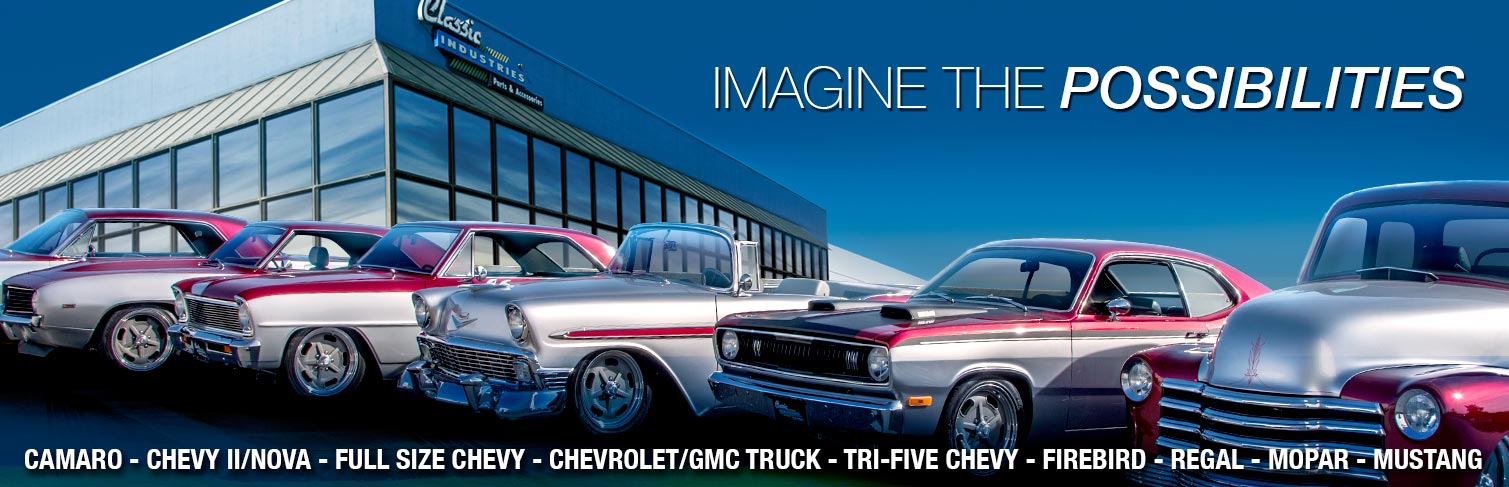
Whether you're restoring your American pony/muscle car to stock or restomodding to the moon or preserving a daily driver to command the boulevards and twisties - Classic Industries is the place to find those must have parts and accessories. Find the parts you need online and enhance the search with a free Classic Industries' Parts and Accessories Catalog.